
A founder with zero Swift knowledge shipped a native voice app for iOS and Android. His previous qualification for building it? A thousand-day Duolingo streak that never taught him to actually speak. If you want to build an app with Codex, his playbook is the most honest template out there right now.
The story in 30 seconds
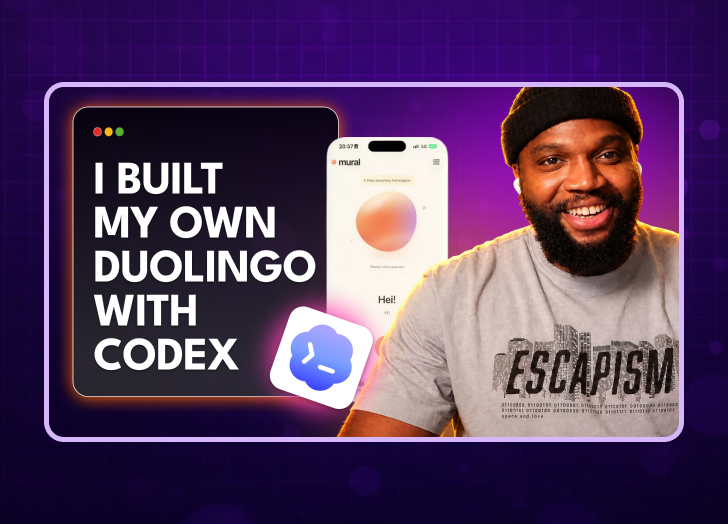
William Imoh runs Hackmamba, a developer marketing company. Chemical engineering degree, self-taught coder, four years as a product manager. After 1,000 days of Duolingo, he moved from Dubai to Norway and discovered the awkward truth: the streak taught him to tap tiles, not to talk.
So he built Mural, a real-time voice app for practicing conversations in Norwegian. He didn’t learn Swift first. He used OpenAI’s Codex as the coding agent and GPT-Live for the live voice engine, and the whole thing is open source on GitHub if you want to peek at what an AI-built app actually looks like inside.
The full build walkthrough is on Lenny’s How I AI podcast. What follows is the part that matters to you: the repeatable moves.
Why this case is worth your time
Plenty of “I built an app with AI” stories fall apart under two questions. Did it actually ship to real app stores? And could someone else repeat it?
Mural passes both. It’s native on both platforms, it’s live, and the code is public. Also, William wasn’t a mobile developer, which makes the workflow transferable to you, whatever your gap is. Yours might be Swift. It might be all of it. When people ask me whether it’s realistic to build an app with Codex as a non-developer, this is the first thing I point at.
The money angle is real too. A working niche app is the entry ticket to app store revenue, a SaaS subscription, or proof-of-work that lands clients. That’s why this belongs on the earn list, not the entertainment list.
Move 1: build for a problem you own
William didn’t pick “language learning” because it trended. He had a specific pain: he needed to SPEAK Norwegian, and nothing he used got him there.
That specificity did two things. It defined the feature (live voice conversation, not more multiple choice). And it gave him an unfair testing advantage: he was the target user, so he could feel when the app was wrong.
If you’re hunting for your first app idea, don’t start from a market map. Start from the thing you complained about this week. It sounds like lifestyle advice, but it’s actually a development strategy: requirements you already understand are requirements an AI can build accurately, and that’s the whole trick when you build an app with Codex.
Move 2: describe the design first
Here’s the detail most people skip, and it’s the one William says mattered most. Before letting Codex generate screens, he wrote out the design language: how the app should feel, what it should look like, what made it different from every other language app.
The result is an app that doesn’t look generated. You know the generic AI app look: purple gradients, rounded cards, suspiciously identical layouts. Design articulation is the cure.
So before your first prompt, write one paragraph describing the visual identity. Reference apps whose feel you want. Say what to avoid. Codex rewards precise articulation the same way a human design agency would, except this one doesn’t bill by the hour.
Move 3: keep the work organized
One prompt doesn’t produce an app, and fifty chaotic prompts produce spaghetti. William used Codex projects to organize the build: separate spaces for different parts of the app, instead of one endless chat where context dissolves. (If you’d rather experiment outside the cloud entirely, our offline coding agent guide covers the local route.)
For your build, the translation is simple:
- One project space per major feature (voice engine, profiles, progress tracking)
- Ask for changes in the space where they belong
- When something works, freeze it and move on
There’s a second reason this matters. AI agents work better with narrow context. Asking Codex to fix the onboarding flow works best when the conversation is about onboarding, not a novel-length transcript of everything you’ve ever prompted.
Move 4: add the hard feature last
Real-time voice is genuinely hard: latency, interruptions, audio quality, the uncanny pause where a tutor takes two seconds to respond and your brain leaves. William added it with GPT-Live, but deliberately late, after the core app existed. Anyone who wants to build an app with Codex should steal that sequencing, because it isolates failures beautifully.
He also tracked the economics and the experience metrics. What GPT-Live costs per session matters when you’re charging nothing yet, and the latency threshold turned out to be the make-or-break number for whether the tutor feels alive.
Sequence your build the same way. Static features first, connective tissue second, the hard real-time piece last. That way the risky part lands on a foundation that already works, and when it misbehaves you know exactly which layer to blame.
Move 5: stay the human in the loop
The models got good. William still reviews what they produce, and he’s specific about what remains his: product judgment, taste, and the decisions about what Mural should be.
His actual fear is telling. It isn’t replacement. It’s dependency. When your entire build capacity lives in someone else’s model, your product lives on someone else’s roadmap. That’s worth remembering before you stake a business on any single tool, and it’s an argument for keeping your skills growing alongside the agents.
The solo founder setup around it
The app was one piece. William also runs Hackmamba, roughly 25 people, mostly solo with agents. He assigned every founder role to a Lord of the Rings character in a Grok Bot fellowship spread across 15 open tabs, with access to everything except one thing.
You don’t need the Tolkien theme. You need the pattern: give each agent a narrow role, keep them in their lane, and stay deliberate about what stays human. That’s the same organizational trick as Move 3, just applied to a whole company.
What to do this weekend
Small version: open Codex and describe the simplest version of your idea. Not the dream version, the version with one screen and one job. Get something running, however ugly.
Bigger version: clone the playbook end to end. Pick your owned problem, write the design paragraph, organize into projects, save the hard feature for last, ship it. Public code like Mural’s exists precisely so you can see the moves in context.
The gap between “I have an app idea” and “I have an app” used to be six months of tutorials. It’s shrinking fast. Learning to build an app with Codex is mostly learning to describe things precisely, and that’s a skill you can practice today. The people who benefit first are the ones who start describing.
Sources: How this founder built a better Duolingo with Codex (Lenny’s Newsletter), Codex (OpenAI), Mural on GitHub