


A woman named Aliyah sits at her workbench, handcrafting belt buckles while tears stream down her face. Her video pleading for support went viral — 6.5 million views, over 800,000 likes, and thousands of comments from people wanting to help her small business thrive. There is just one problem: Aliyah does not exist.
In reality, she is an AI-generated avatar created by scammers to sell mass-produced belt buckles — the exact same ones you can find on Shein for a quarter of the price. Unfortunately, this is not an isolated incident. Fake AI influencers are flooding TikTok, Instagram, and Facebook right now, and they are making real money from real people who have no idea they are being scammed.
In this guide, we will break down exactly how this scam works, who is behind it, and the eight red flags you can use to spot fake AI influencers before they take your money.
What are fake AI influencers?
Fake AI influencers are computer-generated characters designed to look and act like real content creators. While legitimate virtual influencers like Lil Miquela exist with transparency about their AI origins, the ones we are talking about here have no such honesty. Instead, they present themselves as real people running small businesses — often from marginalized backgrounds — to exploit your empathy and trust.
How the scam works
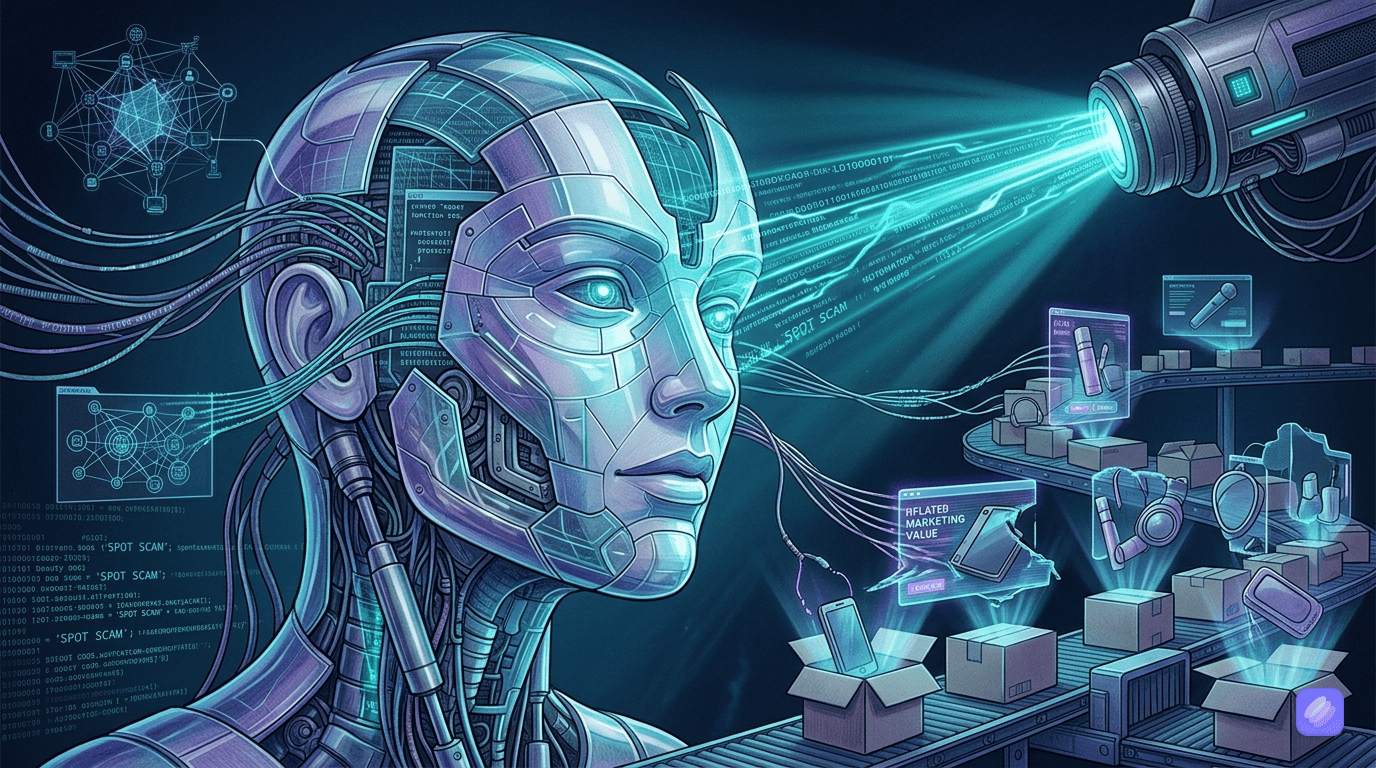
The playbook is surprisingly simple. First, scammers generate a photorealistic character using AI image tools. Next, they create a fictional backstory — usually a struggling entrepreneur facing discrimination or hardship. Then they pair that character with dropshipping products, which are mass-produced items bought cheap from sites like Shein or Temu and resold at a steep markup. Finally, they use AI video generators to create short, emotional clips designed to go viral on platforms like TikTok.
When someone buys a product from one of these fake stores, the scammer pockets the difference between the dropshipping price and what they charged. Meanwhile, the buyer receives a cheap product they could have purchased directly for far less.
The tools behind fake influencers
The tools powering this scheme are not expensive or hard to find. Scammers use Midjourney (around $10-60/month) to generate character images and backgrounds, then turn to video generators like Seedance 2.0, Kling 2.0, or Maxfusion to animate them into short clips. For scripts, they simply feed viral influencer videos into ChatGPT or Google Gemini, which extract the formula and generate dozens of variations in seconds.
YouTube tutorials openly teach this exact workflow, and forums like BlackHatWorld share detailed guides on scaling fleets of fake accounts. The barrier to entry is alarmingly low, which is why researchers at Riddance.ai are discovering up to 100 new fake accounts every single day.
How AI grifters are creating fake influencers on TikTok
Aliyah and the belt buckle scam
Aliyah is the poster child for this trend. Her account, @aliyahsbuckles.store, has racked up 40,000 followers by posting videos of her crying over handmade belt buckles. However, The Verge investigated and found that her "handmade" belt buckles sell for around $40 on her store, while identical products are listed on Shein for just $8 to $10. Moreover, the Verge uncovered dozens of copycat accounts — @amayas.buckles, @harpersbuckles, @legacy.buckles3, and many more — all using nearly identical scripts, backgrounds, and products.
In one video from another account called @amayas.buckles, a white woman throws coffee on the avatar’s belt buckles at a craft fair. The same exact scene appears on @chubbyknots, but this time the avatar is a different character selling crocheted cardigans instead. The scripts change slightly, but the formula stays the same.
Why TikTok is the perfect playground
TikTok is the ideal platform for this scam for several reasons. First, its algorithm pushes content to targeted demographics, meaning scammers can match the avatar to the viewer. Jeremy Carrasco, a researcher at Riddance.ai, explained that a Black woman will typically see AI-generated Black people in her feed, while an Asian user will see AI-generated Asian characters.
Furthermore, the platform trains users to scroll quickly without thinking critically. Carrasco noted that figuring out whether a video is AI-generated usually takes a second or two — but by that point, you have already registered engagement. The platform’s short-form format works against media literacy, making it nearly effortless for scammers to fly under the radar.
How to spot fake AI influencers: 8 red flags
Now for the part that actually matters — here is your checklist. Save this list, refer to it next time you see an emotional product video, and protect both your money and your data.
: voice does not match the emotion
This is the most obvious tell. If someone is sobbing on camera but their voice sounds flat and robotic, something is wrong. AI voice generation has improved, but it still struggles to match the emotional nuance of real human speech. Pay attention to whether the tone of voice aligns with what is happening on screen.
: tears that disappear
In Aliyah’s viral video, she wipes a tear off her cheek, but the stream of liquid below where she wipes vanishes too. AI video generators struggle with physics — water, smoke, and reflections often glitch or disappear. If tears, sweat, or liquids behave strangely, that is a strong indicator the video is not real.
: hands and skin change between shots
AI models still have trouble with hands, and skin tones can shift noticeably between different clips or even within the same video. In many of the scam accounts The Verge investigated, the character’s hands appeared white when holding products but their face was a different complexion. Watch for these inconsistencies.
: videos are always under 15 seconds
Current AI video tools like Seedance 2.0, Midjourney, and Sora cannot generate clips longer than about 15 seconds. If every single video on an account falls within that short window and never shows a longer take, that is a significant warning sign. Real influencers typically post longer content, including tutorials, behind-the-scenes footage, or Q&A sessions.
: identical scripts across multiple accounts
Scammers do not reinvent the wheel. They generate one emotional script and run it through dozens of AI characters. If you notice the same narrative structure, similar phrases, or the exact same scenarios across different accounts, you are likely looking at a coordinated scam operation.
: products available cheaper on Shein or Temu
This is perhaps the most practical red flag. Before buying from any influencer-promoted product, search for the exact same item on Shein, Temu, or AliExpress. If you find it for a fraction of the price, the influencer is dropshipping — and if they are also showing signs of being AI-generated, you have caught a scammer red-handed.
: no verifiable business or real store
Real small business owners typically have a verifiable presence — a registered business name, reviews on other platforms, or a history you can trace. Fake AI influencers, on the other hand, link to Shopify stores with no reviews, no social media history beyond the account itself, and no business registration information. Always do a quick background check before hitting "buy."
: comments feel automated
Many of these fake accounts use AI to respond to comments, and the responses often feel generic or slightly off. Moreover, the comment sections are frequently filled with engagement-bait rather than genuine conversations. If the comments feel manufactured and no one is asking real questions or sharing authentic experiences, proceed with caution.
Who is falling for AI dropshipping scams?
Here is the uncomfortable truth: these scams work on everyone. Regular consumers fall for them daily, but even celebrities are not immune. Gizelle Bryant from The Real Housewives of Potomac admitted on her podcast that she bought two crocheted bags after seeing a video of an AI-generated Black boy claiming he was being bullied for crocheting. Viola Davis was also in the comment section of that same video.
India Cater-Campbell, a real Black business owner opening a café in Seattle, nearly fell for the Aliyah scam as well. She commented wanting to support an independent Black businesswoman, driven by genuine solidarity. Fortunately, she could not find a store link and scrolled away — but not everyone gets that lucky.
The bigger problem: Digital blackface and exploited empathy
Beyond the financial scam, there is a deeper issue at play. Cienna Davis, a communications researcher at the University of Pennsylvania, describes this phenomenon as digital blackface — where people use digital tools to mimic Black cultural expression for economic gain, rooted in the same exploitative tradition as historical blackface minstrelsy.
Tempest M. Henning, a philosophy professor at Fisk University, confirmed this assessment: "Blackface is any kind of caricature-like portrayal of Black people." She pointed out that the avatar names are "coded Black" but lack any authentic cultural signals. The result is a flattening of identity for profit.
These scammers specifically target narratives of racial and class struggle because they know empathy drives engagement. The result is real harm: real Black business owners compete with fabricated accounts that exploit the very solidarity meant to support them.
How to protect yourself when shopping online
You do not need to avoid TikTok Shop entirely, but you do need to shop smart. Before purchasing from any influencer, run through this quick checklist:
- Search the product on Shein or Temu. If it exists there for much less, you are being overcharged.
- Check the account’s history. A real business has a traceable past — look for older posts, different locations, and genuine interaction.
- Look for longer-form content. If every video is under 15 seconds, be suspicious.
- Read reviews outside the platform. Google the store name and check for independent reviews.
- Trust your instincts. If something feels off about the voice, the emotions, or the story, it probably is.
What you can do about fake AI influencers
Awareness is your best weapon. Share this guide with friends and family who use TikTok, especially older relatives who may be less familiar with AI-generated content. Report suspicious accounts directly on TikTok using the in-app reporting tool — select "scam or fraud" as the reason.
Support real creators instead. When you find a genuine small business on social media, follow them, leave reviews, and buy directly from their verified stores. The more we amplify real voices, the harder it becomes for fake ones to compete.
AI is an incredibly powerful tool, and we have covered many ways it can help you make money and save time. However, like any tool, it can be weaponized. Knowing how fake AI influencers operate — and how to spot them — is not just about protecting your wallet. It is about protecting the trust that makes the internet work.