
Smart home gadgets are quietly renting your data back to you. Cameras that charge a monthly fee to see their own recordings, assistants that send every command to some server three states away. UGREEN’s new UGREEN HomeAgent platform takes the opposite bet: it runs AI inside a box in your house, with no monthly bill and no cloud dependency. Here’s what’s actually in it, and whether you should care yet.
What the HomeAgent actually is
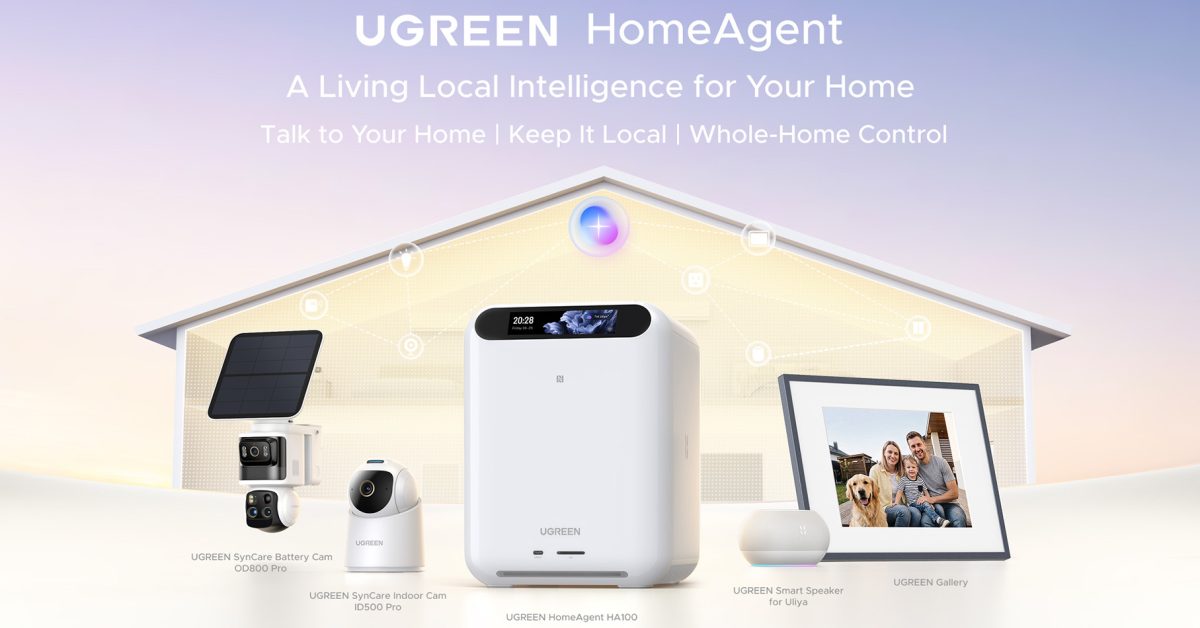
Think of the HA100 (and its bigger sibling, the HomeAgent Pro) as the brain your scattered gadgets have been missing. The hub pairs with your lights, speakers, and cameras, stores their recordings, and processes all of it locally. Not “mostly local with a cloud sync.” Local, on the device, in your house. UGREEN laid out the full ecosystem ahead of launch, and the piece that surprises people is how much of it works without touching the internet at all.
That last part matters more than it sounds. Most consumer smart home setups do their “thinking” remotely: your camera uploads footage, a server decides whether a raccoon or your dog triggered the alert, and you pay for the privilege, usually monthly. UGREEN’s version keeps that decision loop inside the box, and everything it learns from your files stays there too.
The kicker: the UGREEN HomeAgent doubles as network storage. Photos, household documents, backups. Those files become context for the local AI, so you can ask questions about your own stuff without uploading anything anywhere.
Uliya: the assistant that lives in your house
UGREEN’s assistant is called Uliya, and you talk to it directly through the HA100 or through the system’s dedicated smart speaker. The basics work as you’d expect: lights, music, the usual voice assistant chores.
Here’s what makes Uliya different: it can dig through your recordings. Because the cameras feed everything into the hub, you can ask questions about events around your house instead of scrubbing through video clips. Did anything happen in the backyard yesterday? What time did the package arrive? Uliya goes looking and answers.
That’s the real pitch of local AI in the home. Not a fancier light switch. It’s having a memory of everything your cameras saw, that never leaves the building.
Why local changes the math
Here’s the money argument, because “no monthly fee” deserves unpacking.
Typical camera subscriptions run roughly $3 to $10 per month per camera once you want more than a live feed: saved clips, person detection, decent history. Two cameras over three years can quietly cost more than the UGREEN HomeAgent’s entire starting price, and you never stop paying. The local-first pitch flips that: pay once for hardware, and the storage plus the AI analysis run on your own electricity.
There’s a privacy dividend too. Footage from a nursery camera or a backyard with kids in it is exactly the kind of data that shouldn’t roam through someone else’s servers. Keeping it on the UGREEN HomeAgent means a breach at some cloud provider never involves your house, a lesson this month’s Notion AI breach underlined the hard way when customer chats turned up on a third-party provider’s storage.
Fair warning, though: local means your hardware does the work. If the hub’s AI chip is slow or the cameras are mediocre, there’s no cloud fallback to bail the experience out. That’s the bet you’re making.
The cameras do the heavy lifting
A hub is only as good as what feeds it, and UGREEN built a whole SynCare camera line around the HomeAgent.
Flagship outdoor duty falls to the OD800 Pro: three lenses, solar power, built-in battery, no wiring drama. Below it, the OD600 Pro covers outdoor duty at a lower spec. Inside, the ID500 Pro is a pan-tilt-zoom model with 4K imaging, a 360-degree sweep, 160 degrees of vertical tilt, 8x digital zoom, motion tracking, and a baby-cry detector, which tells you exactly which room UGREEN thinks this thing lives in.
Everything else rounds out the ecosystem: two smart frames (an E-Paper model for the wall, an LCD one with video for the shelf), the Uliya speaker, and support for Matter, the industry standard that lets third-party lights and robot vacuums join the party. That Matter support is the release valve for the obvious concern, which is buying into yet another walled garden. And if you already run hybrid setups, our guide to Zapier Sidekick automations shows how cloud tools can still talk to local hardware without locking you in.
Storage with no monthly bill
Here’s the component map, since “ecosystem” is where smart home pitches go to hide the fine print.
| Component | Role in the system | Known spec or price |
|---|---|---|
| HomeAgent HA100 / Pro | Central hub: local AI processing plus NAS storage | Pro tier adds AI power and storage |
| Uliya assistant | Voice control, searches recordings, answers questions | Built into hub and speaker |
| SynCare OD800 Pro | Outdoor camera | Triple lens, solar, battery |
| SynCare ID500 Pro | Indoor camera | 4K, PTZ, baby-cry detection |
| Gallery smart frames | Photo display, integrates with home | E-Paper (wall) and LCD (shelf) |
| Matter support | Third-party device integration | Lights, vacuums, more |
The part worth underlining: there’s no subscription to keep recordings or to access your files, which is the exact fee that most camera companies turn into a decade of quiet payments. Whether UGREEN keeps that promise after launch is a fair question for any first-generation ecosystem, but the starting position is genuinely refreshing.
Price and the long wait
Now the part that should slow your click on the reserve button.
HomeAgent packages start at $799 as a limited early-bird price. Reservations opened September 4, 2026 and run through April 12, 2027, with refundable deposits. The actual Kickstarter campaign launches April 13, 2027. Bigger packages add more AI processing power, more storage, and more device slots. Shipping starts late June 2027.
Read those dates again. This is not a product you buy this year. It’s a reservation for a product you might buy in the summer of 2027, from a company shipping its first-ever home ecosystem, through a crowdfunding platform. The full hands-on at 9to5Google covers the whole lineup if you want the fine print. Early-bird pricing on vaporware timelines is a time-honored tradition, and refundable or not, $799 starter pricing puts this in “serious purchase” territory, not impulse range.
Should you reserve one?
Honest take: most beginners should wait this one out, and that’s not a dig at the concept.
The local-first idea is the right idea. Privacy, no fees, AI that works when your internet doesn’t. But first-generation ecosystems have a rough track record, the ecosystem only wins if the cameras and hubs actually ship and work well together, and your house probably already has lights that answer to something. Reserving now buys you a discount on uncertainty. (If you like the idea of controlling tech from your body instead of your walls, we reviewed the Aina smart ring, which does that for AI agents.)
If the itch is “I want local AI at home,” there are cheaper experiments that teach you the same lessons today. An old PC can become a local AI server for free, and Nvidia’s PAIR setup turns idle hardware into a personal AI node without touching your mortgage budget. Neither one watches your front door, but both will tell you whether living with local AI is your thing before you commit four figures to it.
For a genuinely plug-and-play local assistant experience, the smart-home route will need products like this to mature. Watch the Kickstarter launch in April. If reviews land well in the summer, that’s your moment, not now.
The takeaway
The UGREEN HomeAgent is the most complete local AI smart home pitch we’ve seen: hub, cameras, assistant, storage, all without a monthly fee, at $799 with a long road to mid-2027 delivery. Skip the reservation unless you collect early-adopter bragging rights, and spend a weekend with a free local AI setup first. Your future smart home decisions, and your wallet, will both thank you.