

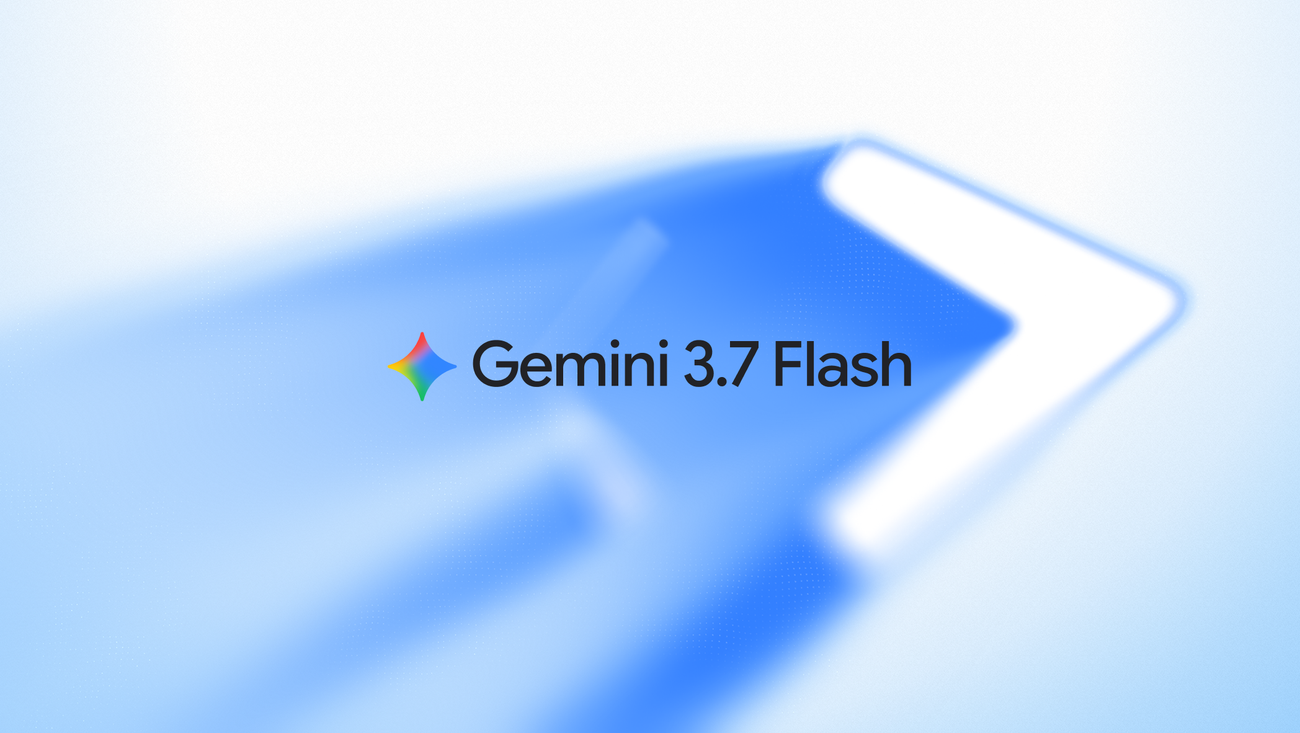

Google just dropped Gemini 3.7 Flash, and it’s already the most upvoted AI story on Hacker News this week with over 700 points. The claim is bold: Google’s fastest workhorse model just got significantly smarter at coding and agent tasks, while cutting the price in half. Here’s what actually changed, what the benchmarks show, and whether you should switch from whatever you’re using now.
What makes Gemini 3.7 Flash different
Gemini 3.7 Flash is the latest in Google’s Flash series, which is designed to be the speed-optimized tier of their AI lineup. Think of Flash as the model you call when you need a response fast and don’t want to burn through expensive API credits on a Pro or Ultra-tier model.
This release came just three weeks after Gemini 3.6 Flash. Three weeks. That’s aggressive even by today’s release-every-month standards. Google says the quick turnaround came from direct developer feedback and what they describe as “algorithmic innovations.”
The headline numbers: Gemini 3.7 Flash scores 56 on the Artificial Analysis Intelligence Index, ranking it 17th out of 188 models tested. It outputs at 340 tokens per second, making it the fastest model in its intelligence class. And the pricing is $0.75 per million input tokens and $3.75 per million output tokens, which is literally half what 3.6 Flash cost at launch.
Coding performance: the benchmarks that matter
Google focused heavily on coding improvements with this release, and the benchmark numbers reflect that.
On FrontierCode 1.1 Main, a benchmark that tests code generation quality, 3.7 Flash scored 43.6 percent compared to 3.6 Flash’s 34.4 percent. That’s a meaningful jump. On DeepSWE v1.1, which tests software engineering tasks like debugging and issue resolution, the improvement is even more dramatic: 65.3 percent versus 49.0 percent.
What does this mean in plain language? If you’re using Gemini to write or debug code, 3.7 Flash is noticeably more likely to get it right on the first try. Fewer iterations, fewer “try again” prompts, less back and forth.
For web development specifically, Google claims 3.7 Flash generates more functional layouts and feature-complete apps in fewer prompts. It scored an Elo of 1588 on Arena.ai’s WebDev Arena, compared to 3.6 Flash’s 1538. Higher Elo means it wins more head-to-head comparisons against other models in real-world web dev tasks.
Beyond coding: knowledge work and reasoning
Google also positioned 3.7 Flash as a strong model for knowledge-dense fields like finance, law, and biosciences. The model showed improved reasoning accuracy on the GDP.pdf benchmark, which tests comprehension of complex professional documents.
The context window stays at 1 million tokens. That’s roughly equivalent to 1,500 pages of text. You can feed it entire codebases, long legal contracts, or comprehensive research papers without truncation. At this point, a million-token context window is becoming table stakes for serious AI work, but it’s still worth noting because some competing models in the same price range offer significantly less.
Speed and pricing compared
Speed is where Gemini 3.7 Flash really separates itself. At 340 tokens per second, it’s the fastest model in its intelligence class on the Artificial Analysis leaderboard. For reference, most models in the same intelligence bracket output between 50 and 150 tokens per second. The difference is noticeable when you’re generating code or long-form content. You wait less.
The pricing structure makes it competitive with both proprietary and open-weight alternatives. At $0.75 per million input tokens, it’s cheaper than GPT-4o-class models and competitively priced against Claude Haiku-tier offerings. The 90 percent cache discount at $0.40 per million cached tokens is particularly useful if you’re making repeated calls with similar system prompts, which is common in agent workflows and automated pipelines.
Here’s how the pricing stacks up against other models at similar intelligence levels:
| Model | Input (per 1M tokens) | Output (per 1M tokens) | Context Window | Speed |
|---|---|---|---|---|
| Gemini 3.7 Flash | $0.75 | $3.75 | 1M tokens | 340 tok/s |
| Gemini 3.6 Flash | ~$1.50 | ~$7.50 | 1M tokens | ~250 tok/s |
| GPT-4o mini | $0.15 | $0.60 | 128K tokens | ~130 tok/s |
| Claude Haiku 3.5 | $0.80 | $4.00 | 200K tokens | ~180 tok/s |
| DeepSeek V3 | $0.27 | $1.10 | 128K tokens | ~80 tok/s |
What “high” reasoning means
Google released 3.7 Flash in two variants: a standard version and a “high” reasoning version. The high variant is the one that scored 56 on the Intelligence Index. It uses extended thinking to produce more thorough answers, similar to how OpenAI’s o1/o3 models work.
The tradeoff is that the reasoning version uses more tokens (and therefore costs more) per query because it generates a chain-of-thought before the final answer. For most everyday tasks, the standard version is fine and cheaper. Use the high reasoning variant when you need the model to work through complex logic, multi-step problems, or detailed analysis.
Should you switch to Gemini 3.7 Flash
If you’re already using Gemini 3.6 Flash in your workflow, upgrading to 3.7 is a no-brainer. It’s faster, smarter, and cheaper. The API endpoint should be a straightforward swap.
If you’re using GPT-4o or Claude for coding tasks, the decision depends on what you value most. Gemini 3.7 Flash is cheaper and faster, but Claude and GPT still edge ahead on certain nuanced reasoning tasks. For high-volume tasks like code generation, automated testing, or bulk content processing where speed and cost matter more than marginal quality differences, Gemini 3.7 Flash is worth trying.
The easiest way to test it is to run the same prompts you’d normally send to your current model through Gemini 3.7 Flash’s API and compare the results. For coding tasks specifically, the benchmarks suggest you’ll see a real improvement in first-pass accuracy.