


You’ve probably heard that AI can write code and generate images. But did you know there’s a new category where playing games actually pays you? Not in vague “play-to-earn” promises that collapsed in 2022. This one uses real infrastructure economics. And it’s live right now.
Most gamers don’t realize they’re sitting on the demand side of a three-sided market. Studios need players. Infrastructure providers need revenue. And a new breed of protocol connects them with tokens that actually mean something.
What Is Vertical DePIN and Why Gaming?
DePIN stands for Decentralized Physical Infrastructure Networks. Fancy term. Simple concept: use token incentives to coordinate real-world hardware. Helium did it for wireless. Filecoin for storage. Render for GPU compute.
Vertical DePIN takes this industry-specific. Instead of generic compute, you get gaming-specific infrastructure plus a player community that’s financially aligned. That’s the difference.
Jon Radoff, who took a content management company public in 2000, built Beamable Network on this thesis. He watched game studios get crushed between rising cloud costs and exploding customer acquisition. His solution: fuse the infrastructure layer with the growth layer.
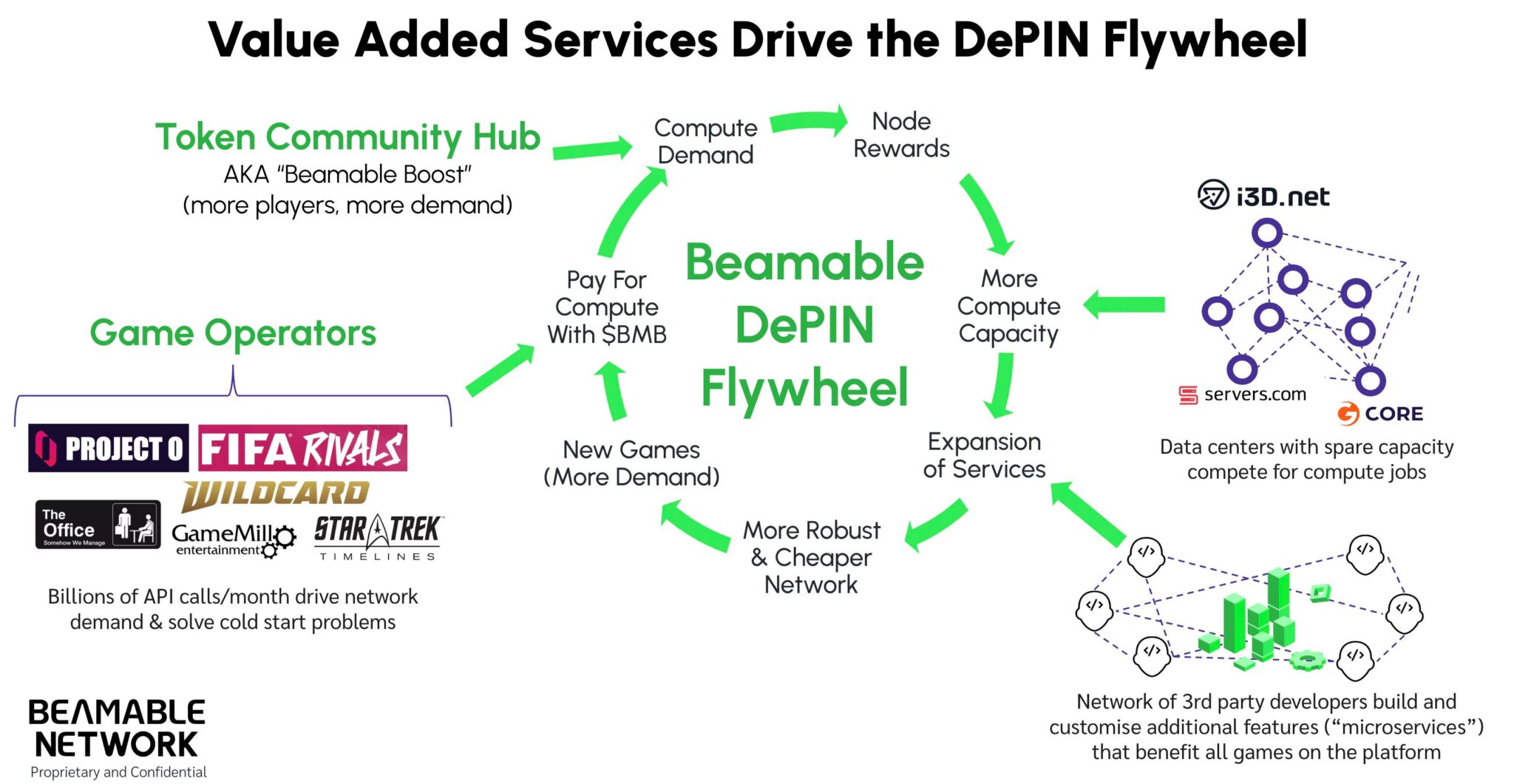
The $BMB token (launching later this year) sits in the middle. Studios pay for backend services. Operators earn for running nodes. Gamers earn for playing, testing, and championing titles.
Sound familiar? It should. It’s the same flywheel that made Uber work — drivers, riders, and the platform all getting value. Except here the “drivers” are gamers, and the “cars” are game servers.
The Three-Sided Flywheel: Developers, Operators, Gamers
Traditional cloud: AWS, Google Cloud, Azure. You pay. They run servers. That’s it. No player acquisition. No community. Just bills.
Generic DePIN: Akash, io.net. Cheaper compute. But still no players. You’re on your own for marketing.
Beamable’s vertical approach adds the third side. The community hub already has millions of accounts and roughly 100,000 connected Steam profiles. These aren’t crypto speculators. They’re gamers who want to support indie studios.
Here’s how each side wins:
Developers get cheaper infrastructure (no cloud markup), faster shipping (Beamable’s SDK handles backend), and instant access to a player base that’s incentivized to try their game.
Operators run nodes, earn $BMB for providing compute and storage. Standard DePIN mechanics, but with gaming-specific workloads that have predictable demand patterns.
Gamers complete quests, test new titles, provide feedback, and earn tokens. Warped Games called Beamable Boost “the single best marketing promotion we’ve ever done.” That’s not marketing speak. That’s a studio that actually saw results.
How Beamable Network Makes It Work
Beamable isn’t theoretical. It’s live infrastructure. The SDK integrates with Unity and Unreal. The backend handles matchmaking, leaderboards, inventory, commerce, live ops — the stuff that usually takes a team of backend engineers.
The token aligns everyone. Studios buy $BMB to pay for services. That creates buy pressure. Operators and gamers earn $BMB. That creates distribution. The protocol takes a cut. That funds development.
It’s a circular economy. Not a ponzi. The difference: real utility. Games need servers. Players want games. The token just makes the exchange efficient.
Radoff’s previous articles lay out the thesis: “Why Scaling Games Is Hard” and “Why the Game Business Is Getting Harder.” Matt Ball’s data shows customer acquisition costs spiraling. Game industry layoffs hit record highs 2022-2025. The old model is broken.
Vertical DePIN is the proposed fix. Infrastructure + distribution + alignment = sustainable game businesses.
How to Start Earning as a Gamer (Step by Step)
You don’t need to be a developer. You don’t need to run a node. You just need to play.
- Join the Beamable Network community hub — Sign up at beamable.network. Connect your Steam account. This verifies you’re a real gamer, not a bot farm.
- Browse available quests — Studios post campaigns: “Play our beta for 30 minutes,” “Reach level 10,” “Find and report 3 bugs.” Each has a token reward.
- Complete the quest — Play the game. The SDK tracks progress automatically. No screenshots to submit. No manual verification.
- Claim your $BMB — Tokens hit your wallet. Hold, stake, or sell. Your call.
- Level up your reputation — Consistent quality participation unlocks higher-paying quests. Early access to betas. Governance voting on which games get featured.
That’s it. No upfront investment. No technical knowledge. Just time and attention — things you’re already giving to games for free.
Beamable Boost: Real Results for Game Studios
Warped Games isn’t the only one. The Boost program matches studios with the community. Studios put up a reward pool. Gamers compete for it. The studio gets players, data, feedback, and word-of-mouth.
Traditional user acquisition: pay Facebook/Google/TikTok. Hope for retention. Usually get neither.
Boost: pay gamers directly. They’re already in your target demographic. They stay because they’re invested. The economics flip.
One studio reported 40% day-7 retention from Boost users versus 12% from paid ads. That’s not a typo. Aligned incentives work.
Vertical DePIN vs Traditional Cloud vs Generic DePIN
| Factor | AWS/Cloud | Generic DePIN (Akash) | Vertical DePIN (Beamable) |
|---|---|---|---|
| Infrastructure cost | High (markup) | Low (spot market) | Low (gaming-optimized) |
| Player acquisition | None | None | Built-in community |
| Game-specific tooling | Build yourself | Build yourself | SDK included |
| Revenue alignment | None | Token only | Token + community |
| Technical barrier | Low | Medium | Low (SDK handles it) |
The table tells the story. Vertical DePIN isn’t just cheaper servers. It’s a different business model.
Is It Worth It? Risks and Reality Check
Tokens can go to zero. $BMB isn’t even tradeable yet. Early participants take risk.
The community could fizzle. Incentivized users sometimes chase rewards, not quality. Beamable’s reputation system helps, but it’s unproven at scale.
Regulatory uncertainty exists. Gaming tokens walk a line. Beamable positions $BMB as utility, not investment. But regulators don’t always agree.
Still — the downside is time. The upside is being early in a model that could rewrite how games get funded and distributed. If you’re already gaming, the opportunity cost is near zero.
What’s Next for Gaming DePIN
Beamable’s roadmap includes tournaments-as-a-service, economy management tools, analytics, and personalization. Each adds utility to $BMB. Each deepens the flywheel.
Other verticals will copy the template. AI DePIN. Mapping DePIN. Science DePIN. The pattern: infrastructure + vertical community + token alignment.
For now, gaming is the wedge. It has the most passionate users, the clearest metrics, and the biggest pain point. Radoff’s bet: solve gaming, then expand.
The question isn’t whether vertical DePIN works. It’s whether you want to participate while it’s still early.
Takeaway: Vertical DePIN flips the script. Gamers become stakeholders. Studios get sustainable growth. Infrastructure gets efficient. If you play games anyway, joining Beamable’s community hub costs nothing and could pay off. Start there. The worst case: you tried some new indie games. The best case: you were early to the next gaming paradigm shift.