


You built an AI agent to find clients on Upwork. It works beautifully — sends personalized proposals, follows up, negotiates rates. You’re getting replies. Then you notice something weird. Everyone else built one too.
Now clients get 50 proposals in an hour. Yours is buried. Response rates tank. The marketplace that used to work… doesn’t.
This isn’t hypothetical. It’s the congestion paradox, and it’s coming for every two-sided platform.
The Paradox: More Agents = Fewer Deals
You’d think AI agents make marketplaces more efficient. Lower transaction costs, better matching, faster deals. That’s true — until everyone has one.
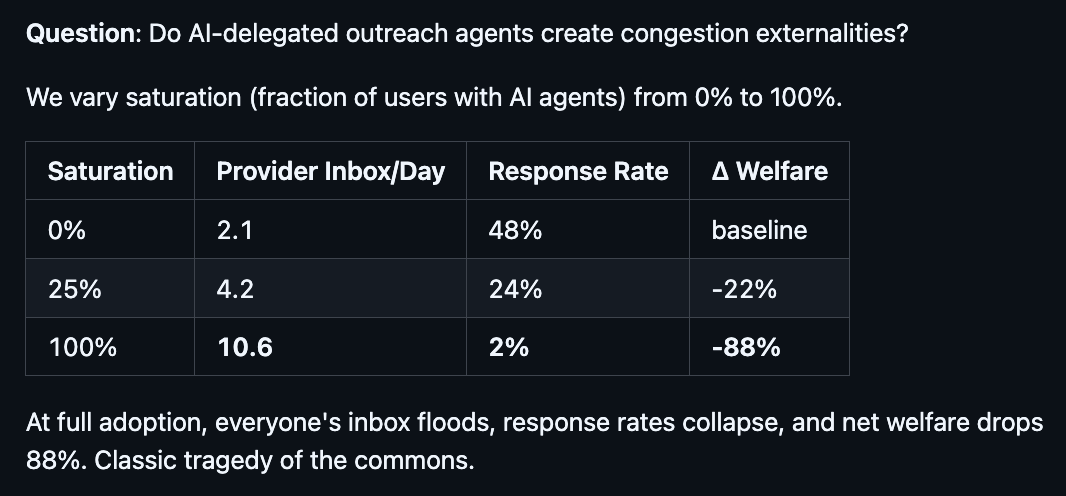
Research from Strange Loop Canon simulated what happens when AI agents flood a marketplace. The results are brutal:
- 5x more requests hitting providers’ inboxes
- Response rates collapse from 48% to 2%
- Net welfare drops 88%
The tragedy of the commons, agent edition: “If everyone has an AI agent, it’s almost like nobody does.”
What the Simulation Shows (5x Requests, 2% Responses)
The simulation modeled a marketplace where customers seek service providers — think Upwork, Fiverr, Thumbtack, but for any service. Each customer has true preferences (price, quality, speed, specialty). Each provider has attributes.
Two matching protocols were tested:
Search (decentralized): You message providers one by one until one bites. Like finding a plumber — call, talk, hire or move on.
Centralized: The platform computes matches for you. Algorithm clears the market based on mutually acceptable terms.
Here’s what happened at full agent adoption:
| Metric | No Agents | Full Agent Adoption |
|——–|———–|———————|
| Requests per provider | Baseline | 5x baseline |
| Provider response rate | 48% | 2% |
| Match quality | Baseline | Collapses |
| Net welfare | Baseline | -88% |
The agents don’t “spam” maliciously. They’re doing exactly what you’d want: casting a wide net, following up persistently, optimizing for your success. But when every agent does this, the system chokes.
Why Search Fails and Centralized Matching Breaks at Scale
Search Protocol: The Plumber Problem
Search works when you’re the only one searching. You call three plumbers, one answers, done.
But when 10,000 agents call those same three plumbers simultaneously? The plumbers stop answering. They can’t. The signal-to-noise ratio destroys the channel.
Agents make search too cheap. They remove the friction that naturally limited how many providers you’d contact. Without friction, everyone contacts everyone. The inbox becomes a DDOS attack.
Centralized Matching: Works for Thin Markets, Dies at Scale
Centralized matching shines in “thin” markets — places where preferences are hard to articulate. Wedding vendors. Specialized consulting. Creative services. Custom manufacturing.
LLMs help here by parsing messy human intent (“I want a website that feels premium but not corporate”) into structured preferences the algorithm can match. The simulation showed AI-powered centralized matching beats search for these markets.
But at scale? Same problem. Every customer’s agent submits preferences. Every provider’s agent submits availability. The matching engine drowns in combinations. Complexity is O(n²) — every customer paired with every provider.
The platform becomes the bottleneck.
The Fix: Prices Are Information Compression
Here’s where it gets interesting. The simulation added one thing: prices.
Not “pricing pages.” An actual exchange where agents bid, ask, and clear based on willingness to pay.
The result: Most welfare recovered. Congestion resolved.
Why? Prices compress high-dimensional information into a single number.
Instead of your agent messaging 50 providers with your full preference vector (budget, timeline, tech stack, communication style, revision policy, timezone…), it posts a bid: “I’ll pay $2,000 for this spec by Friday.”
Providers see the bid. Those who can deliver at that price respond. Those who can’t, don’t. The market clears in O(n) instead of O(n²).
Hayek vindicated, 80 years later: “The price system is a mechanism for communicating information.” AI agents don’t replace that mechanism — they make it more necessary.
What This Means for You Right Now
If You’re a Freelancer on Upwork/Fiverr
Expect more noise. AI-written proposals are already flooding platforms. Clients can’t distinguish yours.
Differentiate on verification, not volume. Platforms that add identity verification, skill tests, reputation scores, and priced proposal slots will win. Look for those features.
Build direct relationships. The marketplace is a customer acquisition channel, not your business. Move clients off-platform fast.
If You’re Hiring via AI Agents
Don’t blast. An agent that spams 100 freelancers gets ignored. An agent that targets 5 with a clear, priced brief gets replies.
Use platforms with pricing signals. Fixed-price projects, budget ranges, milestone structures — these are pricing mechanisms. They filter for serious providers.
Reputation > matching algorithm. A provider with 50 five-star reviews at your price point beats a “perfect match” with zero history.
If You’re Building Agent Tools
Design for congestion from day one. Rate limits. Reputation systems. Priced actions (even micro-pricing: $0.01 per proposal sent). Verification gates.
The winners won’t be “best matching algorithm.” They’ll be “best institution design.” Markets need rules, not just matching.
The Platforms That Will Win (And How to Spot Them)
Watch for platforms adding these features:
- Priced actions — Cost to send proposal, cost to post job, cost to feature listing
- Reputation with stakes — Verified reviews, escrow, dispute resolution, skin in the game
- Identity verification — KYC, skill certificates, portfolio validation
- Agent-native APIs — Structured data exchange, not screen scraping
- Congestion controls — Rate limits, priority lanes, auction mechanisms
Upwork, Fiverr, Toptal — they’re all adding pieces of this. The ones that integrate all of it become the new infrastructure.
Your Takeaway: Don’t Just Match — Price
The agent economy isn’t a matching problem. It’s a coordination problem. And coordination at scale requires prices.
If you’re using agents: build pricing into your strategy. Set budgets. Signal seriousness. Don’t spray and pray.
If you’re building for agents: your competitive advantage isn’t better matching. It’s better institutions. Pricing. Reputation. Verification. Rules with teeth.
The simulation was clear: without prices, the agent economy collapses. With prices, it works better than the human version ever did.
The question isn’t whether pricing comes to agent marketplaces. It’s who builds it first — and who gets stuck in the 2% response rate trap.