


Your meeting ends, the AI notetaker spits out a summary, and then you copy bits of it into an email, a task list, and a calendar invite. By hand. Again. The Superhuman Fathom acquisition is built on a simple bet: that copy-paste step should disappear, and the notes should do the work themselves.
Why Superhuman bought a notetaker instead of building one
Superhuman, the AI productivity suite owned by Grammarly, announced the Superhuman Fathom acquisition this week, bringing the Y Combinator-backed meeting notetaker into its stack. And here’s the interesting part: Superhuman had already tried building its own. The team tested a notetaker internally with select users earlier this year, then went shopping instead.
Shishir Mehrotra, Superhuman’s CEO, was pretty blunt about why. He told TechCrunch that testing “greatly increased our confidence in the demand in this category,” but also made it obvious how deep these products go. His take: a lot of notetakers make the job feel easy, yet it’s “actually quite tricky to do a great job” across everything meeting recording involves.
Buying beats building when the target is good and the market moves fast. Fathom, founded in 2020, had raised over $30 million and was valued at $94 million in 2024, according to PitchBook. Its cap table reads like a tech hall of fame, with Reddit CEO Steve Huffman, former Twitch CEO Emmett Shear, and Cruise co-founder Kyle Vogt among the individual investors.
There’s a lineage worth noticing too. Grammarly bought Superhuman in July 2025, and now Superhuman is adding Fathom. Three products that used to compete for your attention are quietly becoming one AI productivity umbrella.
What happens to Fathom’s free plan
This is the question most people actually care about after the Superhuman Fathom acquisition, because Fathom’s free tier is famously generous. It’s a big reason the app reached more than 400,000 monthly active users, with over 1 million people having recorded meetings on it.
For now? Nothing changes. Fathom keeps operating, and its CEO Richard White framed the deal around reach rather than restructuring. His pitch for selling: Superhuman’s 40 million user base gives Fathom distribution it would need years to build alone. That user figure comes from the combined Grammarly-Superhuman base, which tells you how much firepower suddenly sits behind a notetaker most people still use for free. “If we were to operate Fathom as a standalone company, we would have to build a lot of things that are already in the Superhuman platform,” White told TechCrunch.
History says integration usually comes before price changes. So if you rely on the free plan, the smart move is simple: keep using it, and watch for migration announcements over the next few months.
How Fathom actually works
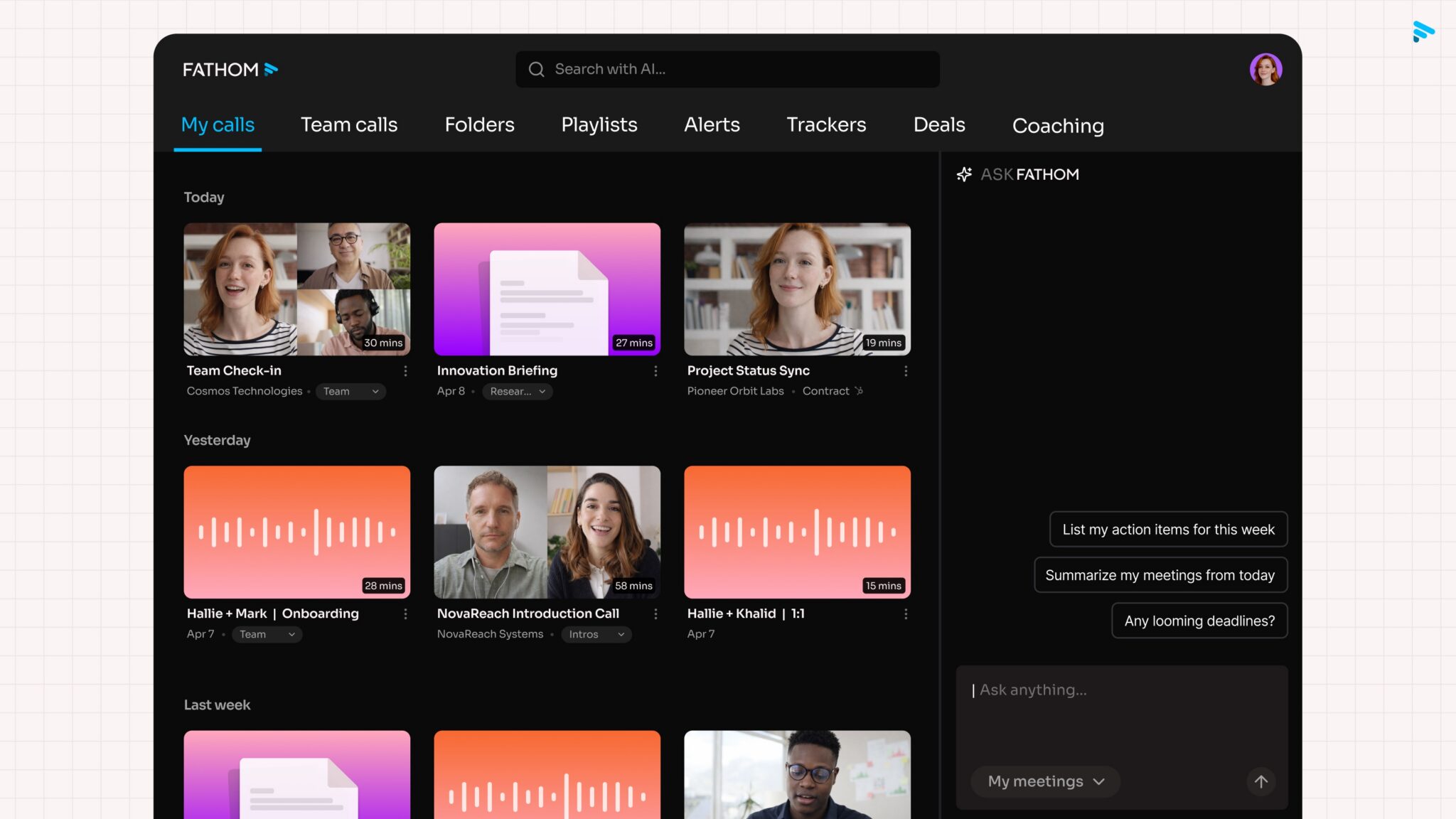
If you’ve never tried it, Fathom does what modern notetakers do: it joins your calls, records the audio, transcribes everything, and produces AI summaries with the action items pulled out. You stop choosing between paying attention and taking notes, because the transcript has both covered.
Earlier this year it rolled out a bot-less meeting mode, meaning the awkward “Fathom is recording” participant can stay off your call entirely. That feature exists mostly to compete with Granola, which built its fanbase on exactly that dislike of joining bots.
The generous free plan is the other big deal. Most competitors cap free users hard. Fathom used unlimited-ish free recording as its growth engine, which explains both the 400,000 monthly active users and why its buyers see value beyond the revenue.
The real story: meetings become the trigger for AI work
Here’s why a notetaker matters to a company that sells email, docs, and calendars. Superhuman’s platform already includes an email client, a docs app, a calendar, a database, and a newly launched AI agent builder. What it lacked was the moment where work actually gets decided, and that’s the meeting.
The idea is that your meeting notes stop being a record and start being an instruction. With a notetaker in the middle of the stack, Superhuman can draft the follow-up email, update the database entry, schedule the next call, and let AI agents extract insights from what was discussed. No human shuffling context between apps.
That matches where the whole industry is pointing. We’ve written before about persistent AI coworkers that hold context across tasks, and the Superhuman Fathom acquisition is the same logic applied to meetings. The transcript becomes the handoff. Action items flow out on their own, and the meeting stops producing homework.
Everyone else is fighting over the same moment
Superhuman isn’t alone here. The meeting-notetaker space has gotten crowded and expensive fast:
| Player | Claim to fame | Recent momentum |
|---|---|---|
| Granola | Bot-free notetaker, enterprise AI app | Raised $125M at a $1.5B valuation in March 2026 |
| Read AI | Notetaker connected to Slack and email | Raised $50M to expand integrations |
| Wispr Flow | Dictation app entering notetaking | New entrant, updated terms hint at launch |
| Fathom | Generous free plan, 400K+ MAU | Acquired by Superhuman |
Venture money keeps flowing into the best AI meeting notes tools because notes alone don’t pay the bills anymore. Notetakers are feeling the heat to become platforms, and the Superhuman Fathom acquisition is the most direct exit possible. In contrast, its rivals now have to explain why they’re still standalone.
What to do if you use Fathom
Short answer: nothing dramatic, yet. But a few moves make sense this week.
- Keep your recordings and exports current, just in case migration tools arrive late or rough.
- Watch for news about how Fathom plugs into Superhuman’s email, docs, and calendar.
- If you pay for a notetaker elsewhere, compare what Fathom’s free tier still offers against rivals in our Fathom vs Fireflies breakdown before your next renewal.
- If you run a small business, note how the combined stack might replace two subscriptions with one workflow. We followed a similar story in our piece on Fathom’s own site and in our look at Claude for small business.
If you’re shopping for a notetaker today
Don’t freeze your decision just because an acquisition happened. The market is genuinely competitive right now, and that’s good for you.
Compare four things: whether a bot joins your calls, how generous the free tier really is, which apps it integrates with, and how good the summaries actually are on your real meetings. Free trials exist for a reason, so run each candidate on an actual call instead of judging by the landing page.
Budget-conscious teams should also look at local options. We reviewed Meetily, a free meeting transcription tool that runs locally, which trades polish for privacy and zero subscription.
Honestly, the Superhuman Fathom acquisition is good news for free users in the short term. Bigger parent, deeper pockets, and a stated plan to keep Fathom’s product at the center of a bigger platform. But when the integration lands, expect the free tier to nudge you toward Superhuman accounts. That’s how these things always go.
The takeaway: your meeting notes are about to get promoted from summary to action items. If you use Fathom, stay put and read the integration announcements carefully. And if you’ve been paying for notetaking plus email plus calendar separately, this is your sign to look at what a connected stack does instead.