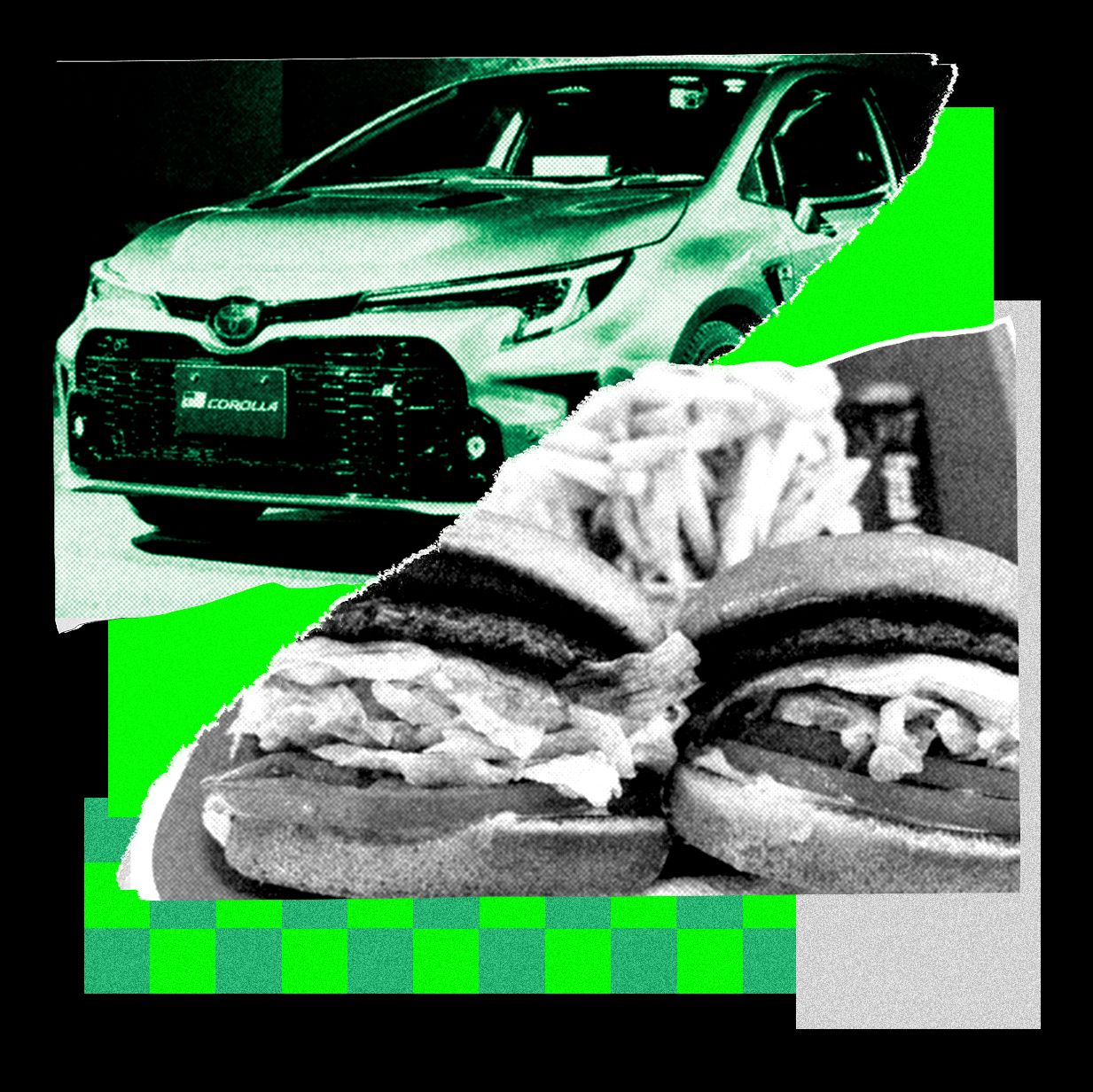

Three engineers got hungry for In-N-Out. Instead of driving, they asked a chatbot to do it. And it worked: a Toyota Corolla rolled up to the drive-thru window with GPT-6 Astra in charge of the steering.
This actually happened, on a real street near the Bay Area, and it says more about where AI is heading than a hundred benchmark charts. Wired got the full story of the AI driving run, and it’s worth your time. Here’s what went down and why a burger run matters for the rest of us.
The burger run, as it happened
The trio works at a startup called Axiom: Aditya Ramabadran, Simon Mahns, and Tobias Gessler. All three are AI engineers. On the day of the experiment, they sat in a 2024 Toyota Corolla near an In-N-Out drive-thru lane with a laptop open.
The setup sounds almost too simple. A chat interface connected to a server. The server linked to several cameras mounted on the windscreen and to the car’s power steering system. That’s it. No special driving hardware, no lidar rig, no months of training on road data.
They typed a request into OpenAI’s GPT-6 Astra: take the wheel. A safety driver sat ready with one foot above the brake the entire time, which tells you exactly how much they trusted it.
The model, built to generate text and code, slowly steered the car up to the take-out window. Stop-and-go, camera input, steering decisions, all live. One of the engineers reportedly said, “Maybe AGI is here after all.”
Wired’s report notes that of the three models the team put in the driver’s seat, GPT, Claude, and Grok, only one managed the trip successfully. GPT-6 Astra got its burgers. The others, apparently, did not.
Why this is weirder than normal self-driving
You’ve seen Waymo cars doing laps around San Francisco for years. So why is a Corolla with a laptop a bigger deal?
Because self-driving companies engineer their systems for the job. Waymo’s stack exists purely to drive: purpose-built perception, prediction, and planning models, trained on millions of road miles. Nothing in that pipeline can write you an email.
The Corolla trick ran the other direction. GPT-6 Astra is a general-purpose model that spends its days answering questions and writing code. Nobody trained it to drive. Nobody fine-tuned it on driving data. The engineers linked cameras and steering to it and asked, on the fly, and it coped.
That’s the headline. A model built for one domain showed enough understanding of the physical world to handle a task from a completely different one. Two years ago, that experiment would have ended in a curb and a viral video of shame. The frontier models crossed some threshold of real-world common sense, quietly, while everyone was arguing about chatbot personalities.
How does a text model steer a car, anyway?
Worth demystifying, because it sounds like magic and isn’t.
The loop goes like this. Cameras on the windscreen capture what’s in front of the car, frames of the road, the lane, the drive-thru lane ahead. Those frames get sent to the model as image input, the same way you’d attach a photo in ChatGPT. The model looks at the scene and outputs a decision: follow that lane, slow down, turn slightly left toward the window. The server translates that decision into commands for the car’s power steering system. Then the cameras capture the new scene, and the whole thing repeats, many times a second.
Nothing in that pipeline is driving-specific. Vision-language models already parse images and reason about them; that’s how you upload a photo and ask what’s wrong with it. The Axiom team just closed the loop by wiring the output side to a steering system. The model was never taught what a car is. It had seen enough of the world, through its training, to cope.
That’s also why it crawled. General models process scenes slower than dedicated driving computers, and nobody was optimizing for speed. Careful and slow was the only safe way to run this.
The part everyone should notice: it was slow and careful
Buried under the AGI jokes is the detail that matters. The car moved “slowly but surely.” A human had a foot hovering over the brake the whole time. This was a demonstration, not a commute.
And that’s the honest state of physical AI right now. The models understand enough to attempt real-world tasks, but nobody, including the people running the experiment, would hand over a highway at speed. The gap between “navigated a drive-thru at crawl speed with a safety override” and “drove you to work” is enormous.
Axiom’s engineers said it themselves: putting a general-purpose model in charge of two tons of steel is a high-stakes undertaking. They did it near a burger restaurant, at low speed, with a brake-ready human. That context gets lost when the clip gets shared without the caveats.
So if you’re wondering whether robotaxis just became obsolete, no. What happened is that a ceiling moved. General models can now touch the physical world, tentatively, which opens the door to everything that comes next.
What “physical AI” means for regular people
The smartest AI models have lived in the world of text and pixels. They can plan your trip, draft your contracts, analyze your spreadsheets. Take them into physical reality and they’ve historically been clueless.
That’s changing, and fast. Researchers are leaving big labs to work on what they call physical reasoning: AI that understands how objects move, how spaces fit together, how cause and effect work in the real world. One of them, Andrew Dai, left Google DeepMind to run a startup called Elorian AI focused on exactly this. His view is blunt: better visual reasoning is essential for robotics, from restaurant robots to home assistants.
The path from burger run to daily life runs through robots more than cars. A model that can steer a car from camera input can, in principle, unload a dishwasher, stock a shelf, or fetch a part in a warehouse. Those are slower, safer tasks where “slowly but surely” is a feature, not a bug.
We’ve tracked this shift from the software side for a while: AI agents moving from simple helpers through eight stages toward autonomous workers, and odd experiments like AI agents colluding in a blackjack setup that revealed how models behave when they interact. The Corolla run is that same story, minus the screen.
What to take from the drive-thru experiment
Skip the hype cycle on this one. Three honest takeaways.
First, the frontier models generalize better than their job descriptions say. GPT-6 Astra, Claude, and Grok are sold as text machines. At least one just drove a car. Your mental model of “what AI can do” is probably six months behind.
Second, the safety caveats are the story, not the footnote. The experiment worked because it was slow, short, supervised, and reversible. Anyone selling you “AI handles the real world now” without those qualifiers is selling something.
Third, watch the physical AI startups this year. When ex-DeepMind people raise money for visual reasoning, and general models pass drive-thru tests on a lark, the pieces are converging. AI agents proved Fermat’s Last Theorem in 11 days a while back; abstract reasoning came first, physical reasoning is the follow-up act.
The next time you pull through a drive-thru and a human leans out the window, consider this: somewhere in the Bay Area, the window just served a car that a chatbot drove there. Slowly. With a foot on the brake. But it got its burger.