


Every hour of audio you transcribe costs money, and those bills add up fast if you run voice agents, podcasts, or customer calls through an API. xAI just released Grok Voice Transcribe 2.0 at $0.10 per audio hour, which undercuts the most popular option by more than 70%. Cheaper is easy. The real question is whether it’s actually good.
What xAI shipped
Grok Voice Transcribe 2.0 is a speech-to-text model that turns audio into text through an API. It went live on September 18, 2026 under the model ID grok-voice-transcribe-2.0, and you can read the official announcement on the xAI blog or check the speech-to-text docs for API details.
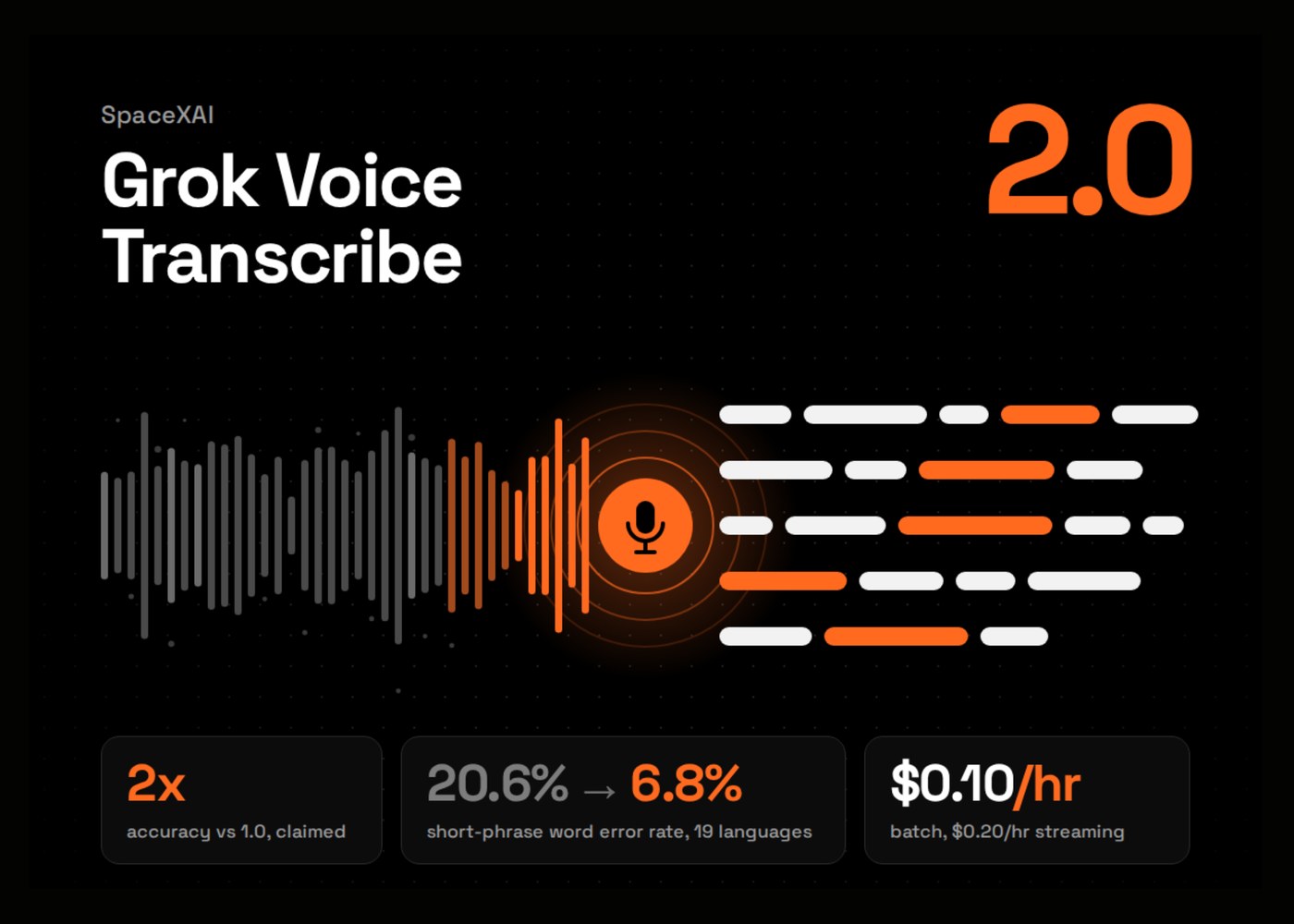
xAI claims it’s twice as accurate as version 1.0 at the same price. The company built it on the same audio foundation model that powers Grok Voice, which already handles tens of thousands of customer-support calls a day and runs the voice assistant in Tesla vehicles. That’s a lot of real-world audio to train on.
The model specifically targets the audio that breaks other transcribers: noisy phone lines, people talking over each other, strong local accents, and spoken credentials like account numbers. It works in two modes, batch (send a file, get a transcript) and real-time streaming (transcribe as someone speaks).
Two numbers from xAI’s benchmarks stand out. Short-phrase word error rate across 19 languages dropped from 20.6% in v1.0 to 6.8% in v2.0. And the model reportedly ranks first among 32 streaming models on the Artificial Analysis leaderboard.
The price comparison that matters
Here’s where it gets interesting for anyone paying a transcription bill today. Grok charges $0.10 per audio hour for batch and $0.20 for streaming. The incumbents charge a lot more.
| Service | Per minute | Per hour | Cost for 1,000 hrs/mo | Streaming |
|---|---|---|---|---|
| Grok Voice Transcribe 2.0 (batch) | $0.0017 | $0.10 | $100 | Yes |
| Grok Voice Transcribe 2.0 (streaming) | $0.0033 | $0.20 | $200 | Yes |
| OpenAI gpt-4o-mini-transcribe | $0.003 | $0.18 | $180 | Limited |
| OpenAI gpt-transcribe | $0.0045 | $0.27 | $270 | Yes |
| OpenAI Whisper API (whisper-1) | $0.006 | $0.36 | $360 | No |
| Google Chirp (Speech-to-Text V2) | $0.016 | $0.96 | $960 | Yes |
Run the math on a real workload and the gap gets loud. A podcast studio transcribing 500 hours a month would pay about $50 with Grok batch versus $180 with OpenAI’s mini model. A company processing 1,000 hours of monthly call recordings saves $260 a month just by switching from whisper-1. Over a year, that’s a car payment.
For streaming, Grok’s $0.20 per hour still beats Whisper’s batch-only $0.36, and Whisper doesn’t stream at all. If you’re building a live voice agent, the comparison isn’t even close on price.
How to run your first transcription
Getting started takes about ten minutes, even if you’ve never touched an audio API before. Here’s the path:
- Create an API key on the xAI console and add a payment method. There’s no subscription; you pay per audio hour.
- Open the speech-to-text section of the xAI API docs. It shows the exact request format for both modes, with the model ID
grok-voice-transcribe-2.0. - For batch, upload an audio file with the model ID set and read the transcript from the response. For streaming, open the streaming connection and send audio chunks as they’re recorded, which is what you’d use for live calls or agents.
Test it on your worst audio, not a clean studio recording. Feed it the noisy phone call, the accented speaker, the meeting where three people talk at once. That’s the whole pitch of 2.0, so that’s exactly what you should benchmark before moving real volume. A simple side-by-side test: run the same 20-hour batch through your current provider and through Grok, then compare transcripts line by line. At 20 hours you’d pay about $2 with Grok batch, $3.60 with OpenAI’s mini, or $7.20 with whisper-1, so the test itself costs less than a coffee either way.
The catch: no open weights
Nothing is free of trade-offs, and this one matters to a specific crowd. Grok Voice Transcribe 2.0 is hosted-API only. xAI has not released open weights, so self-hosting is off the table.
That rules it out if your compliance rules require data to stay on your own servers. It also means xAI can change prices whenever it wants, which is exactly what happened when other providers raised API costs this year. OpenAI’s Whisper, by contrast, has an open-source version you can run yourself if the API ever gets expensive or restrictive.
There’s also the track-record question. The accuracy numbers above come from xAI’s own benchmarks and third-party leaderboard claims, not from my own testing. Artificial Analysis is independent, so the streaming ranking carries some weight, but benchmarks and your phone recordings are different things. Run your worst audio through it before you migrate anything critical.
Who should switch (and who shouldn’t)
Switch if you process real volume: call centers, podcast production, meeting-note apps, voice agents doing thousands of hours monthly. At those numbers, 70% savings is a business decision, not a preference. Batch mode is the no-brainer, since recorded audio is exactly the use case xAI tuned the noise handling for.
Try it first if you’re already on gpt-4o-mini-transcribe. The price gap there is 44%, which is real but smaller, and OpenAI’s mini model is solid. Migrating an entire pipeline to save $80 a month may not survive contact with your engineering backlog.
Skip it if you need self-hosting, if you’re deep in Google Cloud already (Chirp integrates tightly with their ecosystem, even at 10x the price), or if your monthly volume is under ~50 hours. At 50 hours, you’re choosing between $5 and $18 a month. Just pick one and ship.
One more angle worth noting: if your goal is transcription for meetings specifically, a dedicated notetaker app might beat any raw API, because it handles the calendar and the highlights too. We compared the top options in Fathom vs Fireflies, and there’s a whole guide on AI meeting transcription costs if you suspect you’re overpaying. For non-English audio, check our Microsoft MAI-Transcribe-2 explainer too, since multilingual strength varies a lot between models.
The takeaway
Grok Voice Transcribe 2.0 just reset the price floor for serious speech-to-text: $0.10 per audio hour with streaming that costs less than most competitors’ batch. Volume users should test it this week on their messiest audio. Everyone else can wait a month to see if the accuracy claims hold up in production, because the price isn’t going up, but the options are only getting better.