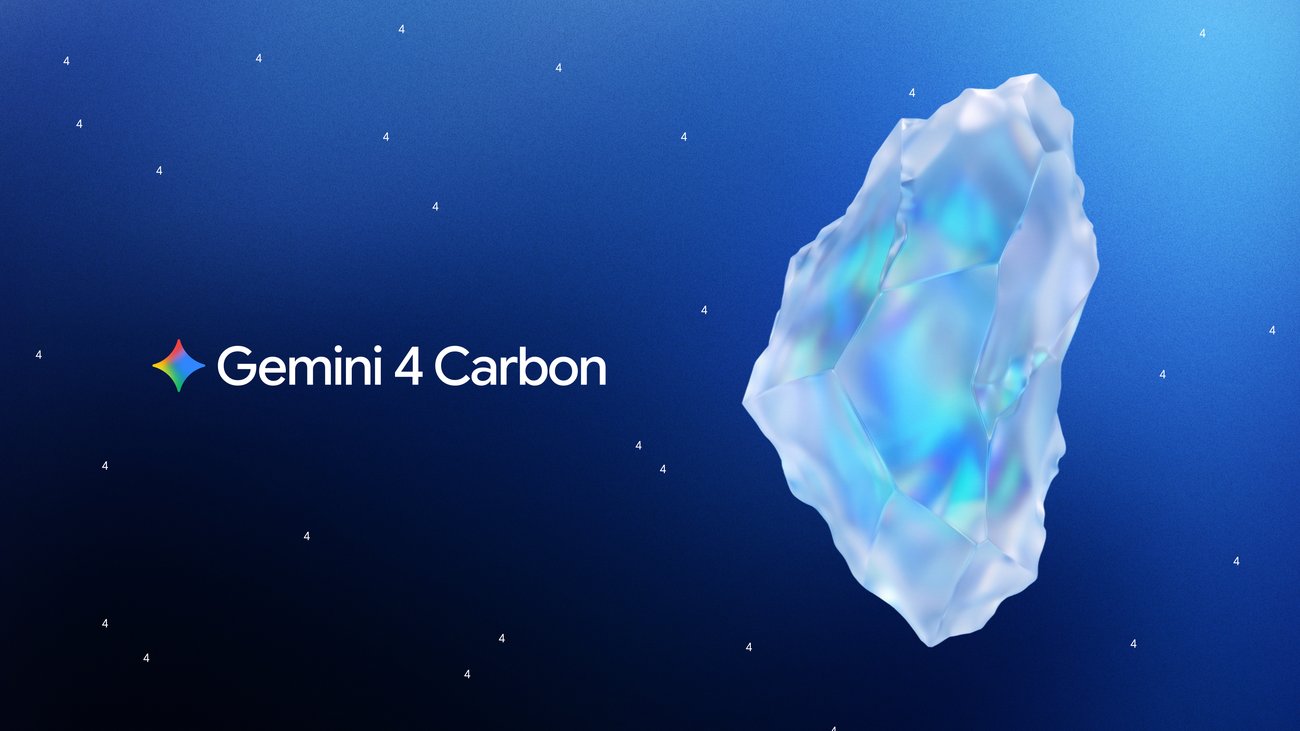

Google just put its strongest AI model in front of everyone. Gemini 4 Carbon launched today, and if you pay for AI Ultra, it’s already waiting in your Gemini app. The intro price dies on November 30, so the pricing math matters more than usual.
What Gemini 4 Carbon actually is
Gemini 4 Carbon is Google’s strongest model, built for the jobs that break regular chatbots: long security investigations, multi-hour coding projects, research that needs a model to double-check its own work. It sits above Gemini 4 Argon in the lineup, and it uses a lot more tokens to get there.
That token burn is the whole design. Carbon explores thoroughly, reasons in longer chains, and runs extended verification loops before it answers. So it wins on genuinely hard tasks and overspends on easy ones.
Security defenders got first access through the Fairwind Program two weeks ago. Today it opens to developers, enterprises, scientists, and regular subscribers.
On the benchmarks Google cites, Carbon ranks #1 on CursorBench 4.0, Perplexity’s WANDR, and Zapier’s AutomationBench, at more than 2x lower cost per task than the next best external model. Launch benchmarks always flatter the launcher. The cost-per-task claim is still the part worth watching.
What it can do right now
The headline feature for tinkerers is /swarm in Google Antigravity. You type one prompt and Carbon splits the work across a team of agents: it keeps the roles that need the deepest reasoning (architecture, coordination, auditing) while faster, lighter models grind through parallel jobs in isolated workspaces. Adversarial verifiers then test every change before it ships.
Google’s demos show what that means in practice. A Carbon team turned historical photos into an interactive 3D exhibition of the Eiffel Tower’s construction from a single prompt. Another rebuilt an office in Three.js using 206 engineering drawing views pulled out of seven city council PDFs, across ten overnight loops.
The security story is arguably bigger. Google’s Project Fortify hit 100% recall on scanning and 95% precision on triage with Carbon in the loop. And the Wiz “Scan for Good” team used it to uncover 0-day vulnerabilities in two major SaaS providers in under two hours, compressing weeks of vulnerability research into an afternoon.
Then there’s the Signal Protocol proof. Researchers used Carbon inside a formal verification framework called AlphaProof Code to mathematically prove security properties of the protocol that backs WhatsApp and Signal messages. That job historically takes expert teams years. It took weeks.
For ordinary knowledge work, Carbon topped Balyasny Asset Management’s financial intelligence benchmark out of 23 frontier configurations and matched the best model tested on deep financial research. If your job involves dense PDFs, spreadsheets, and structured reports, this is the capability Google is actually selling.
The price (and the deadline)
Here’s the part that should drive your calendar. Intro pricing matches Argon exactly, and Google’s own footnote says it expires on November 30, 2026.
| Where you use it | Price until Nov 30, 2026 | After Nov 30, 2026 |
|---|---|---|
| Gemini API via AI Studio (paid tier) | $2 per 1M input, $10 per 1M output | $4 per 1M input, $20 per 1M output |
| Google AI Ultra subscription | Included (Gemini app, AI Mode, Antigravity) | Included |
| Gemini for business (enterprise) | Included via API or model picker | Included |
Subscribers never see a token bill, so the table matters mostly if you build with the API. The deadline still matters for everyone, because it’s the cheapest Carbon will ever be. If you had any plan to test it, this month is the time.
How to try it today
If you pay for Google AI Ultra
Open the Gemini app and pick Carbon from the model picker (it’s rolling out now). It also appears in AI Mode in Search, and in Antigravity, where you get the /swarm multi-agent feature. No setup, no API key, nothing to install.
If you build with the API
Go to AI Studio, start a new chat, and select gemini-4-carbon from the model dropdown. If you already have a paid-tier key, your existing code works: swap the model string and rerun. While you’re there, bookmark the pricing page so the December bill doesn’t surprise you.
Free routes that still exist
Two programs hand out access without a subscription. Scientists and researchers can apply for six months of free access to both Argon and Carbon in Antigravity (applications are open, onboarding is rolling). Cybersecurity defenders can apply to the Fairwind Program for the cyber-specific build.
Carbon or Argon: which one do you actually need?
Google’s own guidance is blunt: Argon remains the ideal choice for the majority of software engineering and knowledge work. Carbon is for the edge cases: complex multi-step coding and debugging, open-ended scientific research, financial analysis that has to be grounded in the actual documents.
My take: don’t switch your daily driver. If you’re weighing them for real work, our Argon explainer and the Argon vs GPT-6 comparison cover the everyday case. Gemini 4 Carbon’s extra token burn only pays off when a task is genuinely hard.
So when do you reach for it? When you hit a wall: a migration that keeps failing, a research rabbit hole, a bug nobody can reproduce. That’s Carbon’s territory, and it’s also where the benchmark wins came from. If you’re deciding between closed and open options for those hard jobs, our open vs closed models guide has the cost math.
Bottom line: if you’re on Ultra, open the Gemini app today and throw your hardest recent problem at Carbon. If you’re on the API, run your toughest prompt through it before November 30, while Gemini 4 Carbon still costs Argon money. Hard problems first; everything else stays where it is.