

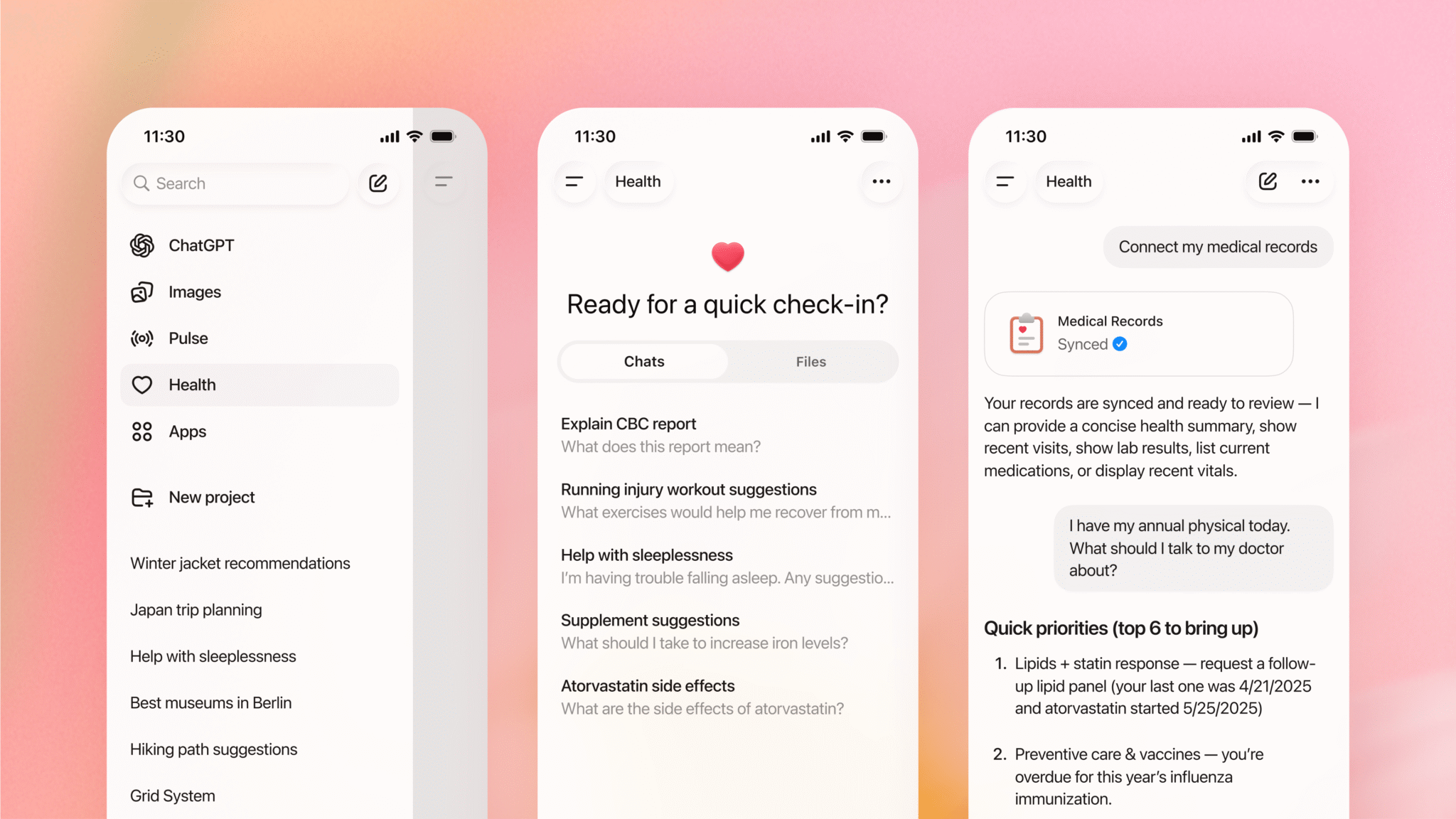

OpenAI just launched ChatGPT Health with Apple Health integration and medical record support. Most coverage focused on what it means for doctors and patients. But there’s a bigger opportunity hiding in plain sight: this is a new category of AI-powered services that entrepreneurs can build right now. AI health side hustles are about to get a lot more accessible.
What ChatGPT Health actually does
ChatGPT Health is a specialized mode within ChatGPT that connects to Apple Health data and supports medical record integrations. It can summarize health data, explain lab results in plain language, track trends over time, and help prepare for doctor visits by generating lists of questions based on your history.
The Apple Health integration is the key part. Apple Health already collects data from millions of iPhones, Apple Watches, and third-party health apps. Sleep data, heart rate, step counts, blood oxygen levels, medication tracking. ChatGPT Health can now read all of that and provide contextual analysis.
It isn’t a medical device and can’t diagnose conditions. But it can spot trends, flag unusual readings, and help people understand their own health data better. For anyone who’s stared at a lab result PDF and thought “I have no idea what any of this means,” that’s genuinely useful.
The AI health side hustle opportunity
Here is the thing most people miss: the value isn’t in the AI itself. OpenAI built that. The value is in the layer between the AI and the person who needs help. There are several viable AI health side hustles here, and none of them require a medical degree.
Health data coaching service
Millions of people wear fitness trackers and never look at the data. A health data coach takes a client’s Apple Health or Google Fit export, runs it through AI analysis, and delivers a plain-English report with actionable recommendations. Not medical advice. Lifestyle recommendations based on patterns in the data.
Charge $50-150 per analysis. The actual work takes 20-30 minutes once you have templates set up. Clients get something personalized that their Apple Watch alone can’t give them: context and interpretation. You are selling the translation, not the data.
Pre-visit consultation prep
Doctor visits are short. The average primary care appointment is 15 minutes. Most patients walk in unprepared, forget to mention symptoms, and leave without getting answers to half their questions. A service that takes someone’s health history, symptoms, and concerns, and generates a structured one-page summary with prioritized questions for the doctor, has real value.
You could charge $25-40 per prep session. Target demographic: elderly patients, busy parents, people with chronic conditions who see multiple specialists. The AI does the heavy lifting. You review, format, and deliver. This is one of the most practical AI health side hustles because the demand is massive and the barrier to entry is low.
Corporate wellness reports
Small and mid-size companies are increasingly offering wellness programs but most of these programs are generic. A service that takes aggregated (anonymized) health data from a company’s wellness app usage and produces a custom report with team-level insights and recommendations is something HR departments would pay for.
Pricing here’s higher: $500-2,000 per report depending on company size. The work is more involved, but the AI handles data analysis and report drafting. You provide the business context and client relationship.
Health content creation for clinics
Local clinics, physical therapy practices, and dental offices need content for their websites, social media, and patient education materials. Most can’t afford dedicated medical writers. AI tools like ChatGPT can draft this content, but it needs a human to fact-check, localize, and adapt it for the specific practice.
This is a straightforward content service with a health specialization. Charge per article or per month for ongoing content. The health angle lets you charge a premium over general content writing because the niche expertise (even at the research level) creates a barrier to entry.
How to start AI health side hustles this week
You don’t need to wait for ChatGPT Health to be available in your region. The tools exist now. Apple Health exports are available to anyone with an iPhone. ChatGPT can analyze spreadsheets and documents today. The health-specific integration makes it easier, but the workflow works without it.
Start by offering free analyses to five people in your network. Use their anonymized health data (or sample data if privacy is a concern) to build example reports. Use those as portfolio pieces. Set up a simple landing page. Post in health and fitness communities. The key differentiator for AI health side hustles is that you’re offering interpretation, not just data dump.
One important note: be very clear about what you’re and aren’t providing. You aren’t a doctor. You aren’t diagnosing anything. You are analyzing trends in self-reported data and providing general wellness observations. Put this in writing, every time. Liability is real in health-adjacent services, and transparency protects both you and your clients.
Why AI health side hustles work better than generic ones
Most AI side hustle advice tells you to “use ChatGPT to write content” or “make AI art and sell it.” Those markets are saturated. Everyone has the same idea. AI health side hustles are different because they require combining AI capabilities with domain context, client communication, and a responsible approach to sensitive information. That combination is harder to replicate, which means less competition and better pricing.
The healthcare industry spends enormous amounts on patient education, wellness programs, and administrative support. Most of that spending goes to expensive consultants and agencies. A solo operator using AI tools can deliver 80% of the value at 20% of the cost. That is the AI side hustle formula that actually works.