


Someone just found evidence that OpenAI is building a wallet feature into ChatGPT. Not a digital wallet for storing crypto or sending money to friends. A wallet that lets ChatGPT itself make purchases on your behalf. The implications are weird, exciting, and slightly terrifying all at once. Here’s what we know, what it means, and why you should be paying attention.
What was found in the ChatGPT app
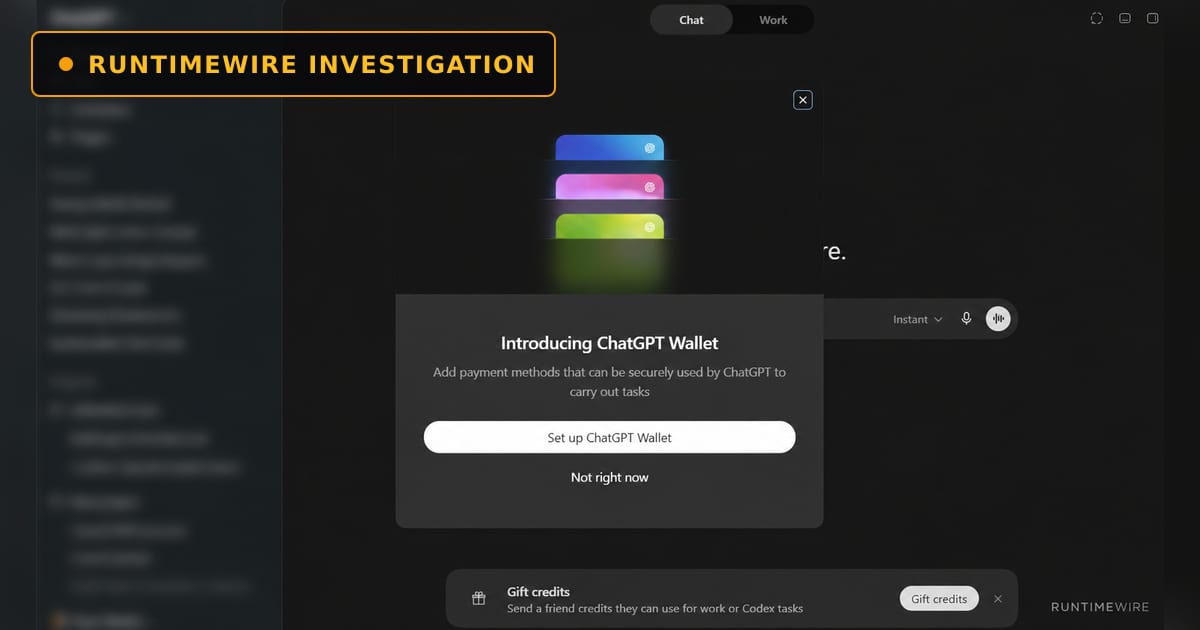
The discovery comes from RuntimeWire, a tech publication that reverse-engineered the Windows desktop app for ChatGPT. Inside the application bundle, they found an unreleased feature called “ChatGPT Wallet” with references to secure card entry, payment method validation, save and retry states, and success confirmations.
The technical details point to a serious product, not a prototype. The feature has its own internal feature gate (ID: 3398492218), a dedicated connector called “connector_openai_wallet,” and a resource path at “internal://wallet-vgs-card-enrollment.” These aren’t the hallmarks of an experiment. This is infrastructure being built for production.
The code was found in Windows package version 26.803.10989.0. RuntimeWire verified it by making byte-length-preserving changes to a cloned application and replacing the enrollment component with a safe introduction-only renderer. No actual payment information was entered during the verification. No previous public report of this feature existed before their investigation.
How a ChatGPT wallet would actually work
Based on the code found, here’s how the ChatGPT Wallet would likely function:
You’d add a credit card or payment method to ChatGPT, similar to how you save a card in Amazon or Google Pay. Once saved, ChatGPT could use that payment method to complete purchases when it’s acting as your agent. The secure card enrollment flow suggests encryption and tokenization for storing payment data safely.
This is different from OpenAI’s previously announced “Instant Checkout” feature, which was more about letting merchants embed ChatGPT-powered checkout on their websites. The wallet is about ChatGPT initiating purchases, not just facilitating someone else’s transaction.
Think about what this enables in practice. You could tell ChatGPT “find me the cheapest flight to Denver next Friday under $400 and book it.” Or “order more coffee beans from the supplier we used last month.” Or “renew our domain name before it expires.” The AI handles the search, the decision, and the payment all in one flow.
Why this matters for AI automation
Right now, AI agents are mostly limited to digital tasks. They can write emails, generate code, analyze data, and create content. But the moment they need to spend money, the flow breaks. You have to step in, open a browser, pull out your credit card, and complete the transaction manually.
A ChatGPT wallet closes that loop. It turns ChatGPT from an assistant that tells you what to do into an agent that actually does it, including the part where money changes hands.
For businesses, this could be transformative. Imagine AI agents that automatically reorder office supplies when inventory runs low. That book client travel when a deal is confirmed. That pay for software subscriptions after getting approval. The automation potential is enormous, and it’s exactly the kind of thing the “agentic AI” everyone’s been talking about needs to actually deliver on its promises.
The obvious concerns
Let’s not pretend this is all upside. There are real concerns with letting an AI spend your money.
Spending control
What stops ChatGPT from making an unauthorized purchase? The code suggests there are success and retry states, which implies some form of confirmation flow. But the details aren’t clear yet. Users will need clear spending limits, approval thresholds, and easy ways to revoke payment access.
Security
Storing payment credentials in an AI application creates a high-value target. If ChatGPT’s wallet gets compromised, the attacker doesn’t just get chat history. They get a stored credit card. The secure card enrollment code suggests OpenAI is thinking about this, but the stakes are high enough that any security flaw would be catastrophic.
Accidental purchases
AI models sometimes misinterpret instructions. “Order the office supplies” could be interpreted as “order everything in the office supplies catalog” if the model hallucinates or takes an instruction too literally. Spending safeguards aren’t optional here. They’re the difference between a useful feature and a financial disaster.
Regulatory scrutiny
Giving AI agents the ability to initiate financial transactions will attract attention from regulators. The EU’s AI Act already has frameworks for high-risk AI systems. Financial transactions initiated by autonomous agents will almost certainly fall under increased regulatory oversight.
What this tells us about OpenAI’s strategy
This wallet feature reveals something important about where OpenAI sees ChatGPT going. They’re not just building a chatbot. They’re building a platform where ChatGPT acts as an intermediary between you and the digital world, including commercial transactions.
The mention that this “reopens native commerce after OpenAI shifted checkout toward merchants in March” suggests OpenAI initially tried to work with merchants on checkout flows, then realized they needed to own the payment layer themselves. That’s a significant strategic shift. Owning the payment layer means OpenAI controls the transaction data, can potentially take a cut of purchases, and builds a moat that competitors can’t easily replicate.
What you should do now
This feature hasn’t launched yet. It exists in the code but hasn’t been officially announced. When it does launch, probably in the coming weeks or months based on how far along the code appears to be, here’s what to keep in mind:
First, don’t connect your primary credit card on day one. Use a virtual card with a low spending limit or a dedicated debit account. Test the feature with small purchases before trusting it with anything significant.
Second, set up spending alerts on whatever payment method you connect. Most banks and card issuers let you set real-time notifications for purchases above a certain amount. This gives you a safety net even if ChatGPT’s own safeguards fail.
Third, pay attention to the approval flow. If OpenAI requires explicit confirmation for every purchase, the wallet is basically just autofill with extra steps. If they allow autonomous purchases within spending limits, that’s where the real automation value lives, and that’s also where the risk is highest.