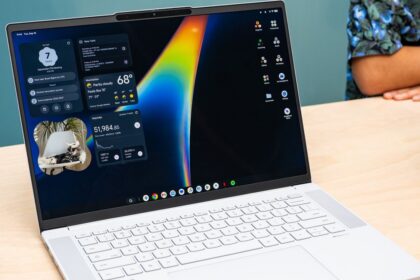


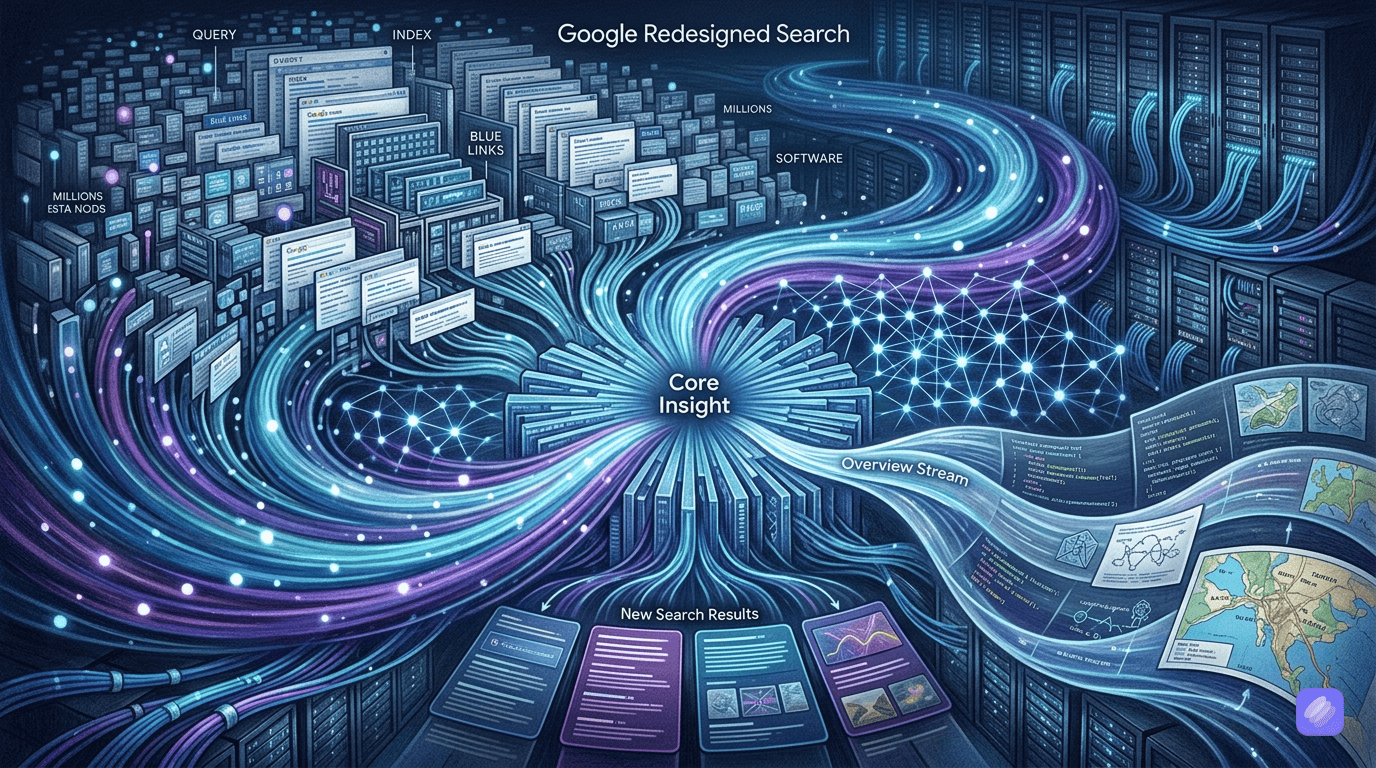

If you’ve typed anything into Google in the last few weeks, you might have noticed something different. The familiar list of blue links — the one we’ve all been using since 2000 — is getting replaced by an AI-generated answer that sits right at the top of the page. Google redesigned search, and it’s the biggest change in a quarter century. Whether you run a website, a small business, or just rely on Google to find answers, this affects you directly.
What actually changed in Google Search?
On May 19, 2026, at Google I/O, the company announced what it calls the “intelligent search box” — a new search experience powered by Gemini AI. Instead of showing you a list of websites to click through, Google now generates a complete answer right on the results page. You can ask questions, upload images, even use voice — and get a conversational, AI-generated response.
The new “Intelligent Search Box”
The search box itself has changed from a simple text field into what Google calls an intelligent entry point. Think of it less like a keyword finder and more like having a conversation with a very knowledgeable assistant. You can ask follow-up questions, refine your search naturally, and get answers that actually understand context — not just match words.
AI Overviews now dominate results
AI Overviews — the AI-generated summaries that appear at the top of search results — now reach 2.5 billion users across more than 200 countries and 40 languages. As of March 2026, 48% of all Google Search queries show an AI Overview. That’s up from just 6.49% the year before — a staggering 58% jump in a single year. In practical terms, nearly half of every search someone does now starts with an AI answer, not a link.
AI Mode: The full AI Search experience
Google also expanded AI Mode, which launched in March 2025. This is the full AI-first experience where the entire results page is AI-generated. It supports text, images, and voice input. Over a billion people now have access, and crucially, Google is rolling out a free tier alongside the premium one. Previously, you needed a Google One AI Premium subscription — now anyone can try it.
Beyond these core changes, Google also announced Information Agents (24/7 AI assistants that monitor topics and proactively surface updates), Generative UI (interactive widgets and mini-apps that appear inside search results), and Mini Apps in Search (full app experiences embedded directly in results). Everything is rolling out through summer 2026.
Google redesigned Search: The numbers
48% of searches now show AI answers
That number deserves its own section because of what it means. Almost one in every two searches on Google now displays an AI-generated summary before any traditional results. And those summaries take up serious screen real estate — a Botify study found that AI Overviews plus featured snippets occupy 67.1% of the desktop screen and 75.7% of the mobile screen. Content ranked number one might not even be visible without scrolling.
2.5 billion users worldwide
AI Overviews have expanded far beyond the US. Over 2.5 billion users across 200+ countries can now see AI answers in their search results. This isn’t a test or a beta — it’s the new default for nearly half the planet’s searches.
What Google Search looks like now (before vs. after)
Before: You search “best CRM for small business” and see ten blue links, each leading to a different blog post, comparison site, or product page. You click through three or four before finding an answer.
After: You search the same thing and see a comprehensive AI summary at the top — pricing comparisons, feature breakdowns, even pros and cons — all generated from multiple sources. The blue links are still there, but they’re pushed below the fold. Many people never scroll past the AI answer.
That shift from “here are some websites” to “here’s the answer” is the fundamental change. It’s not a visual refresh like the 2015 logo update. This is a completely different paradigm for how people find information.
What this means for your website traffic
This is where things get serious for anyone who relies on Google to drive visitors.
Why “ranking #1” doesn’t mean what it used to
For two decades, SEO has been about getting your website to the top of Google. Rank first, get the clicks, grow your business. But when an AI Overview answers the user’s question before they even see your link, ranking first becomes less valuable. According to the Botify study, more than two-thirds of the screen on desktop and three-quarters on mobile is consumed by AI answers and featured snippets. That leaves very little room for traditional results.
Real businesses are already losing traffic
This isn’t theoretical — major companies are already feeling the impact:
- Chegg, the education platform, sued Google in February 2025, claiming AI Overviews direct students to “low-quality, unverified AI summaries” instead of visiting actual websites. Chegg simultaneously explored selling itself.
- Penske Media Corporation (publisher of Rolling Stone and The Hollywood Reporter) sued Google in September 2025, alleging AI Overviews illegally regurgitate their content and drive away visitors. They found that 20% of searches linking to their sites displayed AI Overviews instead.
- Reddit saw its stock drop in May 2025 after Google expanded AI Mode, even though Reddit is the second most-cited source in AI Overviews (behind Quora).
If companies the size of Rolling Stone and Chegg are worried, small business owners and solo creators should absolutely be paying attention.
How to adapt: What you should do right now
Google redesigned search, but that doesn’t mean you’re powerless. Here are three concrete steps you can take today.
1. optimize for AI citations (not just rankings)
The new game isn’t just about ranking — it’s about getting cited by AI. When Google’s AI generates an answer, it pulls from sources. Being one of those sources is the new top-of-page placement. Focus on clear, authoritative content that directly answers common questions in your niche. Google’s own documentation puts it simply: “Optimizing for generative AI search is optimizing for the search experience, and thus still SEO.”
2. focus on direct answers in your content
AI Overviews favor content that gives clear, direct answers. Structure your content with concise answers to specific questions — use H2 and H3 headings that match what people actually search for. If someone asks “how much does X cost” or “what is Y,” make sure your page answers that question within the first sentence or two, then expands.
3. monitor your AI Overview appearances
Check whether your content is appearing in AI Overviews. If it is, you’re already winning the new game. If it isn’t, look at which sources are being cited instead and figure out what they’re doing differently. Tools like Semrush and Ahrefs now offer AI Overview tracking specifically for this purpose. In fact, our article on Agent A by Ahrefs covers how AI-powered SEO tools are becoming essential for this new landscape.
The bigger picture: Why everyone from Rolling Stone to Chegg is suing Google
The lawsuits tell a bigger story about what’s happening. Publishers argue that Google is essentially taking their content, summarizing it with AI, and serving it to users who never visit the original site. The EU has even launched an investigation into whether AI Overviews breach European competition law. A Google patent filed in 2026 raised further concerns about the company potentially replacing website landing pages with AI-optimized copies in search results.
Meanwhile, the technology itself is still imperfect. Early AI Overviews famously told people to eat rocks and put glue on pizza (May 2024). In January 2026, a Guardian investigation found dangerous medical inaccuracies in AI health summaries, forcing Google to restrict AI Overviews on health-related searches. A Canadian musician even sued Google after AI Overviews falsely claimed he was a convicted sex offender.
These problems will likely improve over time. But the structural shift — from websites to AI answers — is here to stay.
FAQ: Google Search redesign
What did Google change in their search?
Google replaced the traditional link-based search results with an AI-powered “intelligent search box” that generates conversational answers using Gemini AI. AI Overviews now appear on 48% of searches, and a free tier of AI Mode is available to everyone.
When did Google redesign search?
Google announced the redesign at Google I/O on May 19, 2026, and is rolling it out through summer 2026.
How does AI Mode work on Google?
AI Mode generates an entirely AI-powered results page. Instead of showing links, it creates a comprehensive, conversational answer from multiple sources. It supports text, images, and voice input, and over a billion people now have access.
What are AI Overviews?
AI Overviews are AI-generated summaries that appear at the top of standard Google search results. They pull information from websites across the web and present a concise answer before the traditional list of links.
Will Google’s AI search hurt my website traffic?
It depends. Sites that rely on being found through traditional search links may see declining traffic. However, sites that create clear, authoritative content that gets cited by AI can still thrive. The strategy shifts from ranking for clicks to being cited as a source.
What is GEO (Generative Engine Optimization)?
GEO is the emerging practice of optimizing content so that AI engines cite and surface it in their generated answers. It builds on traditional SEO but focuses on semantic relevance, direct answers, and authority rather than just keywords and backlinks.
Can I opt out of AI Overviews?
Website owners can use existing Google controls to limit how their content appears in AI Overviews, but there is no universal opt-out. Google has not provided a simple toggle to block AI Overview citations entirely.
Why is Rolling Stone suing Google?
Penske Media Corporation, publisher of Rolling Stone and The Hollywood Reporter, sued Google in September 2025. They allege that AI Overviews illegally reproduce their content in AI summaries, driving visitors away from their actual websites.
Internal links
- Agent A by Ahrefs — AI Marketing Agent That Knows SEO — relevant when discussing GEO/AEO tools and AI-powered SEO optimization
- Google Gemini Spark: The 24/7 AI Assistant That Actually Works — connects Google AI search to the broader Gemini product ecosystem
- OpenRouter Raises $113M Series B: What This Means for AI Users — relevant when discussing the broader AI ecosystem disruption
External links
- Google’s AI Optimization Guide — Google’s official guidance on optimizing for AI search
Suggested images
- Before/after screenshot comparison: Old Google Search (10 blue links) vs. new AI-first results page
- Infographic: 48% of searches now show AI Overviews (stat visual)
- Timeline graphic: Google Search evolution (2000 → 2015 logo → 2026 AI redesign)
Schema Markup
- Article schema (required)
- FAQ schema for the FAQ section
- HowTo schema: NOT appropriate for this article
Word count: approximately 1,950 words