


Claude Code is great until you look at your credit card statement. Between the $20 Pro plan and the $200 Max tier, running an AI coding agent all month costs real money. There’s now a free Claude Code alternative that runs on your own machine, and it’s genuinely good.
Why coders are looking for a way out
Claude Code earned its reputation. It plans, writes, tests, and fixes code across your whole project, and plenty of developers treat it as a coworker instead of a tool. Then the usage caps hit.
Here’s the actual math. Claude Pro costs $20 a month and includes Claude Code, which is fine for light use. Heavy users get pushed toward the Max plans, and Max 20x runs $200 per month. That’s a car payment for some people. Meanwhile, if you want to use a different model, you can’t. Claude Code speaks to Anthropic’s models, period.
So the question shows up in every developer forum: can I get this same workflow without the subscription? Lately, one answer keeps coming up. It’s called Qwen Code, and it’s not a stripped-down trial app. It’s a genuine free Claude Code alternative, and it happens to be open source.
What Qwen Code actually is
Qwen Code is an open-source AI coding agent that lives in your terminal, the same way Claude Code does. You point it at a project folder, type what you want, and it reads files, edits code, runs commands, and reports back. As a free Claude Code alternative, it holds up surprisingly well.
A few facts worth knowing upfront:
- It’s licensed under Apache 2.0, so it’s free for personal and commercial use
- The project has around 27,800 stars on GitHub and is under very active development
- It was originally built on Google’s Gemini CLI, then heavily extended
- It supports multiple AI protocols, so you can plug in Qwen, OpenAI, Anthropic, Gemini, or a local model
That last point is the big one. Claude Code is locked to Anthropic’s models. Qwen Code doesn’t care where the intelligence comes from. You bring the model, and the agent handles the rest.
And it’s not missing features, either. Its official repo lists subagents, agent teams, MCP support, plan mode, IDE plugins for VS Code and JetBrains, and session management. Feature-wise, the README’s comparison table shows parity with Claude Code on almost every row. Where Qwen Code pulls ahead are the openness rows: model choice and open source, both ways.
The honest catch about “free”
Before you delete your Anthropic account, let’s be precise, because a lot of articles get this wrong.
Qwen Code, the tool, is free. It will always be free, because open source.
The hosted Qwen models used to have a generous free tier through the tool’s OAuth login. People were getting 1,000 to 2,000 requests per day at no cost. That ended. Alibaba discontinued the Qwen OAuth free tier on April 15, 2026, and new sign-ins through that route get rejected now.
So where does “free” actually come from in 2026? Two real paths.
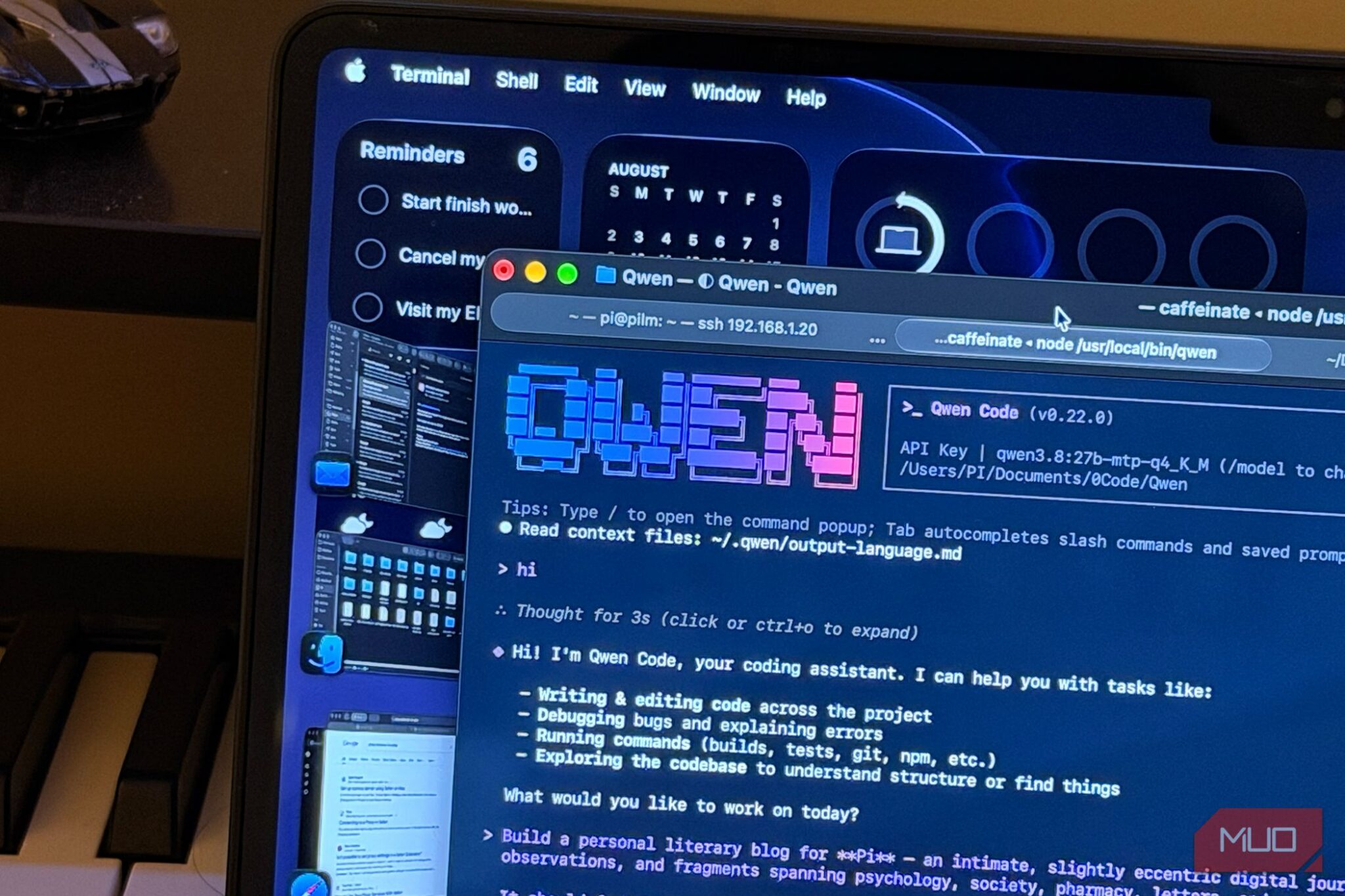
Path 1: run the model on your own hardware. This is the one making headlines. Alibaba released official weights for Qwen 3.8 27B, a dense model small enough to fit on a consumer GPU with 24GB of VRAM. The team at MakeUseOf ran it on an RTX 3090, a five-year-old gaming card, and measured about 75 tokens per second. That’s fast. And since the model runs locally, there are no API bills, no rate limits, and no internet requirement once it’s downloaded.
Path 2: route through free or cheap API access. Qwen Code connects to providers like OpenRouter and Alibaba Cloud ModelStudio. Free tiers exist on these platforms, though quotas change often, so check current limits before you commit.
The takeaway: the agent is free, but the intelligence needs to come from somewhere. If you own a suitable GPU, that somewhere can be your desk, and then the whole setup truly costs nothing per month.
How to set it up in about 10 minutes
The setup is simpler than most people expect. Here’s the whole process.
- Install Node.js if you don’t have it. Qwen Code needs a recent version, and the installer at nodejs.org handles everything.
- Install the agent with one command in your terminal:
npm install -g @qwen-code/qwen-code. Mac users can also grab it through Homebrew. - Start it inside a project. Navigate to your code folder and type
qwen. You’ll get the same chat-in-terminal experience Claude Code users know. - Connect a model. Type
/authand pick your provider from the list: a cloud provider like OpenRouter or ModelStudio, or a local endpoint such as Ollama or LM Studio running Qwen 3.8 27B. - Give it a real task. Try something like “Explain this repository and show me where to start.” That’s the official quick-start prompt, and it’s a good honesty check for whatever model you attached.
That’s it. No config files to hand-edit, no API wrangling beyond one auth screen. If you’ve used Claude Code before, the muscle memory transfers directly.
What it’s like on real hardware
The MakeUseOf test is the most useful data point so far, because they ran the local 27B model on an RTX 3090 and did real work, not toy demos. Their verdict: the results felt close to Claude Opus tier for everyday coding tasks, at 75 tokens per second on a card you can buy used for around $600.
They also asked it to design an entire blog site, and it handled the multi-file work without falling apart. Is it literally identical to a frontier model on hard problems? No. The honest framing comes from other developers running the same setup: the local model won’t replace Claude for the hardest 20% of tasks. It absolutely can handle the mechanical 80%, the renames, the tests, the refactors, the boilerplate.
Which raises the obvious question. Why pay $20 to $200 a month for tasks a free local model does just as well?
That’s the hybrid play most people land on. Local Qwen Code for the daily grind. Claude Code for the genuinely hard sessions. Your bill drops from a subscription to roughly zero.
Qwen Code vs Claude Code
Here’s the side-by-side, based on the official repos and pricing pages:
| Qwen Code | Claude Code | |
|---|---|---|
| Price | Free (open source, Apache 2.0) | Included with Pro at $20/mo; Max up to $200/mo |
| Model choice | Any: Qwen, OpenAI, Anthropic, Gemini, local models | Anthropic models only |
| Runs offline | Yes, with a local model | No, cloud only |
| Hardware needed | Any computer for cloud models; ~24GB VRAM GPU for local | Any computer, work happens in the cloud |
| Agents, MCP, plan mode | Yes | Yes |
| IDE plugins | VS Code, JetBrains, Zed | VS Code, JetBrains |
| Data leaves your machine? | No, when running local models | Yes, always |
That second-to-last row matters more than it looks. Both agents have the same core feature set now. The differences are about control: who owns the model, where the code gets sent, and what happens to your wallet.
When you should stick with Claude Code
Honesty requires this section.
If you work on large, complex codebases and push the agent hard, Claude’s frontier models still win those sessions. Qwen’s own benchmarks for Qwen 3.8-Max were literally measured using the Claude Code harness, which tells you who the reference standard is. Also, if your machine is a five-year-old laptop with integrated graphics, the local path is closed, and cloud API costs for heavy use can quietly approach a subscription anyway.
There’s also a middle option people forget about. Claude Code can technically be pointed at other providers through community routing tools, but you lose features when you do it, so most comparisons call it a downgrade. A real free Claude Code alternative shouldn’t work like that. Qwen Code keeps the whole feature set intact because openness is its default mode, not a hack.
For more on what today’s coding agents can catch, see our guide to Claude Code debugging and our look at Cognition SWE-2, a frontier coding model at a much lower price. And if the local route interests you, we also covered how Nvidia PAIR turns idle computers into a free AI data center.
The takeaway
If you pay for Claude Code and your usage sits in the casual zone, install Qwen Code this weekend, point it at a local Qwen 3.8 27B or a free API route, and see where it gets you. As free Claude Code alternatives go, this one has real software behind it, not just hype. Worst case, you’ve lost ten minutes. Best case, you just cancelled a subscription.
Grab the installer from the official Qwen Code GitHub repo, and keep one Claude session a month for the tasks that truly need frontier muscle.