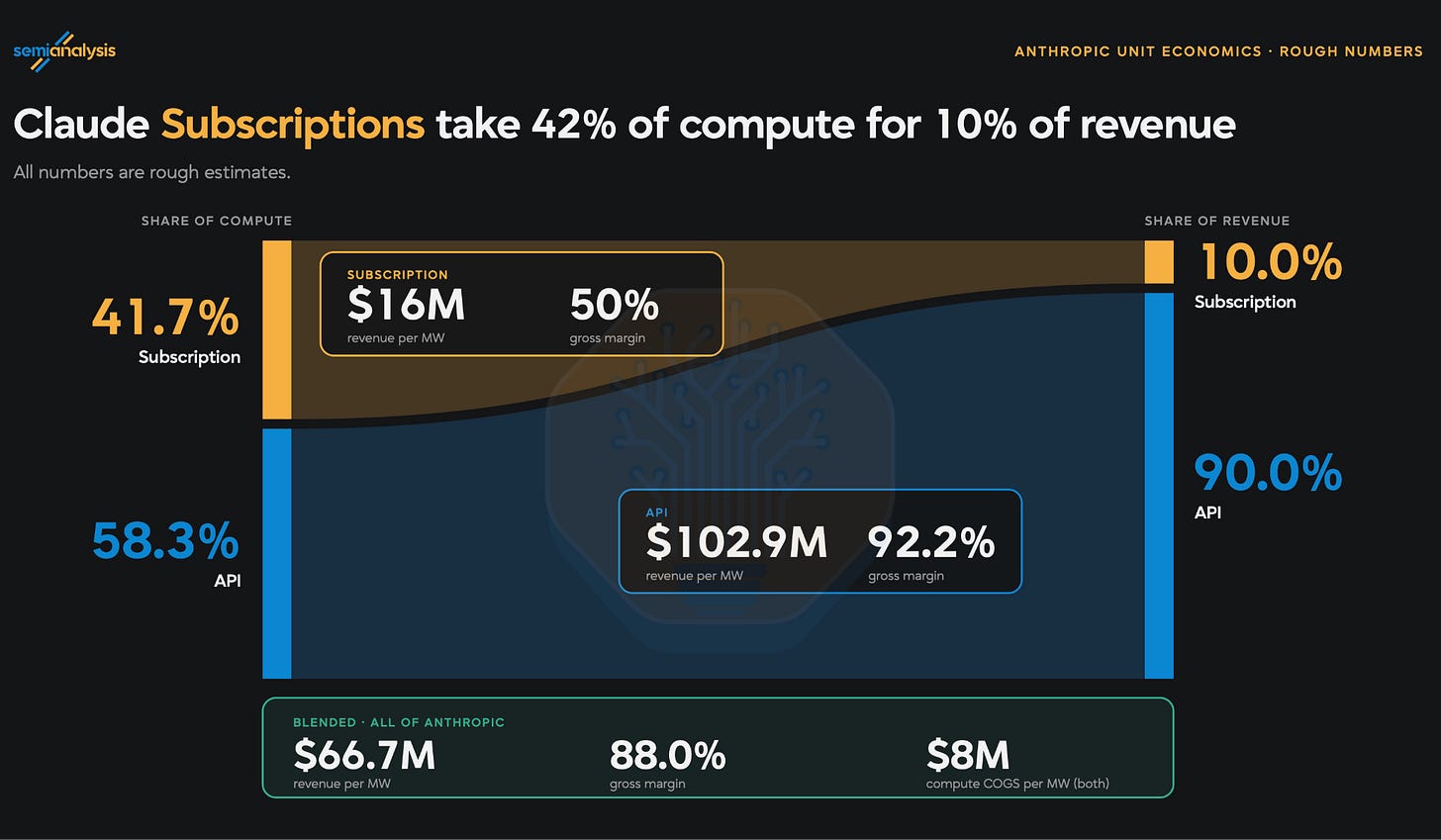

You pay for AI subscription plans expecting roughly the same deal: a flat monthly fee, no meter running. A limit test published by SemiAnalysis on October 5 found the same $200 buys wildly different value depending on which logo sits on the bill. Their math puts Claude’s top plan at five times the usable output of the comparable ChatGPT tier for heavy workloads.
The problem: AI subscription plans hide their real price
Every pricing page sells you the same fantasy. One number, one month, unlimited-ish everything. Then day three arrives, you hit a cap you never saw coming, and the chatbot politely asks you to wait three hours.
Here’s what’s actually going on. Your monthly fee buys a bucket of internal credits, and every model drains that bucket at a different rate. Ask a cheap fast model a question and the bucket barely dips. Run an agentic coding session on a frontier model and you can drain a whole day’s allowance in one afternoon. As a result, the “value” of a plan isn’t a number on a page. It’s a three-variable formula: plan, model, and workload.
Pricing pages don’t show you that formula. So most people guess, overpay, or burn out their limits by Tuesday and blame themselves.
What SemiAnalysis actually tested
The SemiAnalysis team (Andrew Megalaa, Max Kan, and Dylan Patel) didn’t just read pricing pages. They limit-tested subscriptions from Anthropic, OpenAI, Meta, Cursor, Cognition, Z.ai, MiniMax, and Moonshot, converting each plan’s real-world allowances into API-equivalent dollars.
Their conclusion cuts against the default assumption that ChatGPT Plus is the safe default purchase. Measured as API-equivalent value, Anthropic’s plans came out roughly five times more generous than OpenAI’s for comparable spend. Meanwhile, the report notes these subscriptions are massively subsidized: at Anthropic, subscriptions are only about 10% of revenue but can consume over 40% of inference compute. Somebody is eating the difference, and for now it’s the labs, not you.
One more finding worth your attention. Anthropic has repeatedly walked back planned limit cuts after user backlash, while OpenAI’s generous resets helped fuel a surge in Codex adoption. In other words, limit policy is a competitive weapon right now, and it’s moving in your favor if you pay attention.
The price list: what you pay in October 2026
Before picking a winner, here’s the verified lineup from both pricing pages. Compare the AI subscription plans side by side.
| Plan | Monthly price | Usage allowance | Fits |
|---|---|---|---|
| Claude Free | $0 | Base allowance | Trying things out |
| Claude Pro | $20 ($17 on annual billing) | 5x Free per 5-hour session | Daily individual work |
| Claude Max 5x | $100 | 5x Pro per session | Heavy daily users |
| Claude Max 20x | $200 | 20x Pro per session | Agentic coding all day |
| ChatGPT Free | $0 | Limited access | Light questions |
| ChatGPT Go | $8 | Expanded limits | Budget users |
| ChatGPT Plus | $20 | Expanded limits, full model menu | Regular professional use |
| ChatGPT Pro | From $100 (3 usage tiers) | Maximum limits, priority access | Power users |
Two things jump out of that table. First, ChatGPT’s entry tier is dramatically cheaper: $8 Go versus Anthropic’s $20 floor for anything useful. Second, at the top, both labs charge $200, yet SemiAnalysis’s credit math says those two $200 bills convert into very different amounts of actual work.
Why Claude plans stretch your money further
The 5x figure comes down to how each lab prices internal usage. SemiAnalysis found that credit cost ratios inside subscriptions don’t match the API price ratios. A model that costs 10x more per token through the API might only burn 2x the credits inside a plan, or the reverse. Because of that mismatch, the same monthly fee effectively buys different amounts of intelligence depending on where you spend it.
For heavy workloads (long coding sessions, big document analysis, agent runs), Claude’s credit pricing leaves you with far more headroom. That’s the whole story behind the headline. It’s not that Claude is “better.” It’s that Anthropic currently converts your $200 into more raw compute than OpenAI does.
Honestly, this shouldn’t surprise anyone watching the two companies. OpenAI is juggling massive infrastructure costs and hundreds of millions of users. Anthropic is buying market share with subsidized limits and betting you’ll stay for the quality. For example, when Anthropic planned to cut limits in September, user backlash made them reverse course within days. Subscribers have real bargaining power right now, at least until the market tightens.
Which plan actually fits you
Skip the spreadsheet. Here’s the decision tree I’d give a friend.
If you use AI a few times a week for emails and quick questions: ChatGPT Go at $8 is the best deal in the market, full stop. Don’t buy more.
Maybe you work with AI daily but in normal-size chunks: Claude Pro at $20 (or $17 annual) currently buys more sustained usage than ChatGPT Plus at the same price, per SemiAnalysis’s testing. If your workflow lives inside OpenAI’s ecosystem (custom GPTs, Dots, Codex habits), Plus is still fine. But on pure value per dollar, Pro wins right now.
Or you run agents and code with AI for hours every day: Claude Max 5x at $100 is the sweet spot, and Max 20x at $200 is the clear winner if Claude Code is your main tool. Twenty times a Pro session allowance is not a marketing rounding error. It’s the difference between working all morning and working all week.
The pick for most readers: start on Claude Pro, watch your limit warnings for two weeks, and only jump to Max if you’re hitting caps before lunch. That’s it. That’s the whole decision.
The catch nobody mentions
Value isn’t frozen. Labs quietly adjust credit costs when new models ship, and SemiAnalysis builds a whole business around tracking these drifts daily because the numbers move that often. That $200 worth of headroom today can shrink next month without a single announcement.
Watch the fine print too. Anthropic’s own help docs admit the company “may limit your usage in other ways, such as weekly and monthly caps.” So your allowance technically comes with a speed limit and a fuel gauge, and only one of them gets a headline. When these AI subscription plans change, the change usually lands silently.
There’s also the workload trap. If your tasks are mostly short chats with a fast model, the gap between plans narrows a lot, because cheap models barely touch anyone’s bucket. The 5x advantage shows up almost entirely in heavy, frontier-model work. If you’re not doing that, you’re comparing numbers that don’t apply to you.
And one more thing: limits aren’t the only feature. If your job depends on ChatGPT-specific integrations or you’ve built automations on OpenAI’s stack, switching costs are real. We covered how limit drops hit Claude Code users in September, so the grass isn’t automatically greener on either side.
What to do this week
Open your AI app and check your actual usage pattern: how often do you hit limits, and on which model? Then compare that pattern against the table above and do the honest math. If you’re a heavy user on ChatGPT Pro, SemiAnalysis’s data says your same $200 works harder on Claude Max 20x right now. Light user? Stay on Go, pocket the difference, and recheck this comparison in a month, because these AI subscription plans will look different by then.
Want to go deeper on picking models rather than plans? Read our Claude Opus 5.5 vs GPT-6 Sol breakdown, or learn how to double your Claude Pro usage without upgrading before you spend another dollar.