
Claire Vo runs ChatPRD, a one-person AI company, and token fraud ate tens of thousands of her dollars over the past year. Not hackers guessing passwords. Fraudsters farming her free trials, reselling her promo codes, even installing a hidden worker that used her product as free compute around the clock.
If you build anything with AI, or you’re planning your first AI side hustle, token fraud is the scam nobody warns you about. The good news: the attack patterns are well documented now, and the defenses are mostly free.
What token fraud actually looks like
The core idea behind token fraud is simple. When you sell AI, you sell compute, and compute costs real money on every request. Fraudsters have figured out dozens of ways to get that compute while someone else pays the bill.
Claire Vo described six abuse patterns she personally dealt with on her podcast, and they’re a museum of modern scams. Bots mass-creating trial accounts. Stolen or resold promo codes. People wrapping her product in “relay” services and selling access. Even a custom MCP integration that ran her tool as a 24/7 compute worker for somebody else’s project.
The scale surprised her, and it surprises most founders. One person’s free trial means nothing. Ten thousand fraudulent trials at $0.40 of compute each means bankruptcy.
The gray market behind token fraud
This isn’t random kids messing around. There’s an organized market, and security researchers at Okta mapped it out in a recent threat intelligence report.
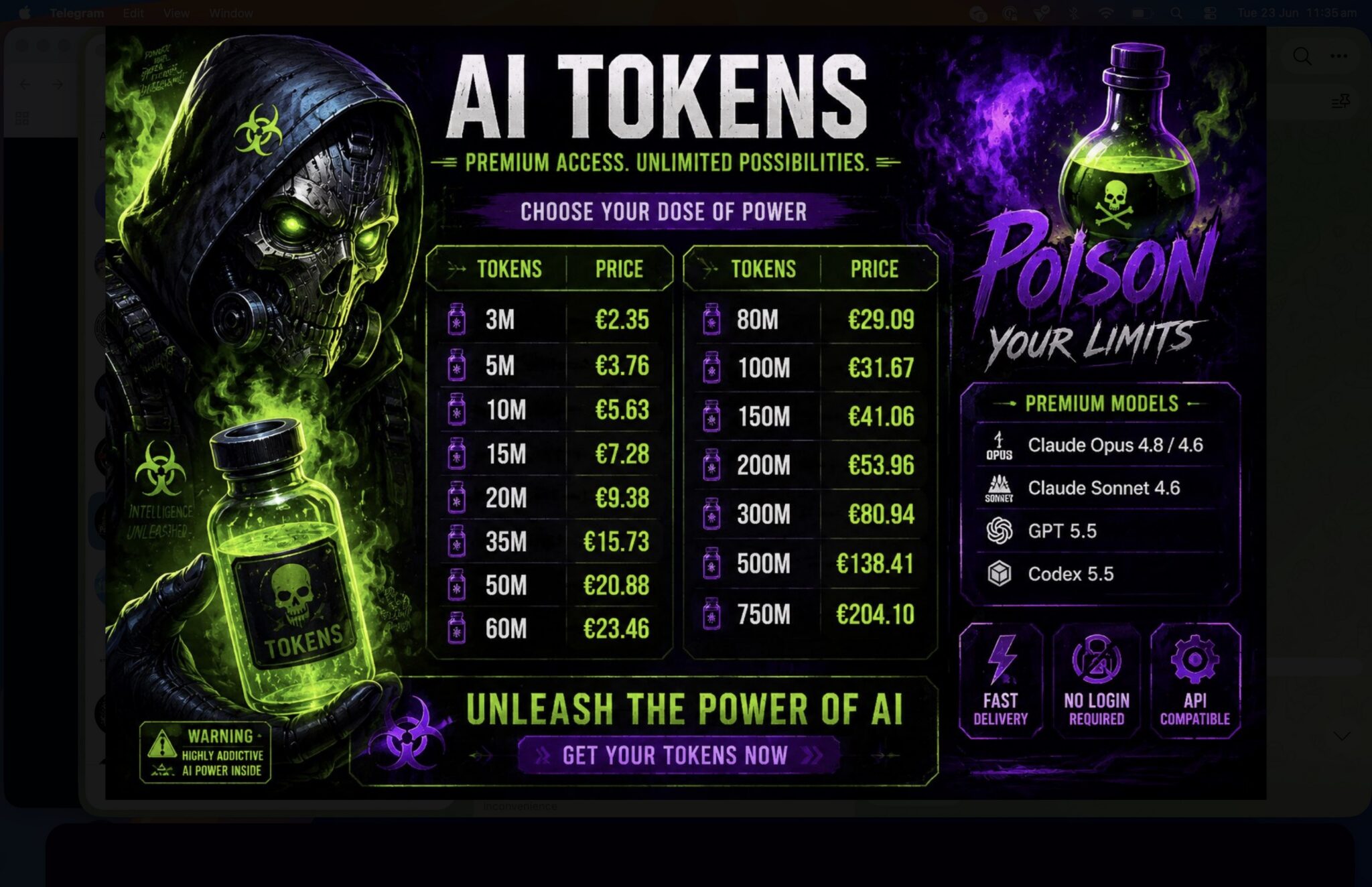
Their findings on the gray market for AI accounts read like a crime documentary. Sellers offer AI subscriptions and tokens at 70-90% off official prices. The demand comes from places where frontier models are banned or blocked, plus bargain hunters everywhere. Chinese-language “relay stations” operate on Telegram and Taobao with uptime dashboards, customer support, and crypto payments. Some run API gateways like LiteLLM or OpenRouter under the hood to survive account shutdowns.
The providers are fighting back. Anthropic started requiring government ID verification through Persona for some new accounts, and it built fingerprinting systems to catch abuse patterns across time zones. Still, the market keeps growing because the economics keep working.
There’s a privacy kicker most buyers never consider: every prompt you send through a relay station passes through the seller’s hands. Whatever you type can be logged, sold, or leaked. That cheap Claude access might cost you your business ideas.
Six defenses you can set up this week
You don’t need an enterprise security team. Each of these took Claire Vo or other solo founders days, not months, and every one applies to a small AI project.
1. Kill open free trials. This is the big one, and it’s why Vo killed hers entirely. Free trials are the front door for farm attacks. If you must offer one, gate it behind card verification or require a government ID for anything beyond a tiny taste.
2. Rate-limit everything. Cap requests per account, per hour. A human never needs 500 requests in ten minutes, but a fraudster reselling your service does. Every major AI provider’s dashboard lets you set spending caps too. Set a hard monthly limit on your own API keys right now, today, before anything else.
3. Watch for the weird patterns. New accounts that immediately hit max usage. Signups from one IP range. Usage at 4am in a timezone that doesn’t match the billing address. Vo eventually built a real-time classifier that flags token fraud as it happens, and she credits it with saving the business.
4. Treat promo codes like cash. Because that’s what they are on the gray market. Unique single-use codes, expiry dates, and a dashboard check of who redeems what. A code posted to a deal forum dies fast.
5. Lock down your own keys. The flip side of token fraud is the stolen API key. That famous horror story of the small company billed $82,000 in 48 hours after a leaked Gemini key started with one exposed credential. Keys go in environment variables or secret managers, never in code, never in screenshots, and rotate them if any teammate leaves.
6. Know where to report it. In the US, the FBI’s Internet Crime Complaint Center takes these reports, and provider abuse teams do respond to evidence. You won’t always get money back, but reports feed the systems that catch the farms.
Here’s how the attacks and defenses line up:
| Attack pattern | What it looks like | Your defense |
|---|---|---|
| Trial farming | Many signups, one behavior | Card or ID gate, rate limits |
| Promo abuse | Codes spreading on deal sites | Single-use codes with expiry |
| Relay wrapping | Your product sold at 70% off | Usage caps, anomaly alerts |
| Hidden compute workers | Odd MCP or automation usage | Audit integrations monthly |
| Stolen API keys | Massive bill spike overnight | Hard spending caps, key rotation |
| Account takeover | Email changes, new devices | 2FA everywhere, alerts |
The math that makes token fraud personal
Here’s the uncomfortable part for beginners pricing an AI product. Your margins are thinner than you think, so token fraud hurts more than you’d expect.
Say your AI side hustle charges $10 a month and each customer costs you $1 of compute. Fine, 90% gross margin, healthy business. Now a fraudster runs 500 fake accounts doing maximum usage. That’s $500 of compute burning monthly against revenue that doesn’t exist, and if trials are free, you’re paying entirely out of pocket.
This is exactly how the small company with the stolen Gemini key ended up facing bankruptcy. The bill doesn’t care that the usage wasn’t yours.
If you’re building with AI agents instead of serving them, the same paranoia applies to what your own agents cost. The piece An AI agent deleted his files. Yours is next if you skip this covers what happens when agents run without guardrails, and ArtEx AI hacking tool: what it is and how to stay safe shows how attackers weaponize AI itself. Fraud protection and agent safety are the same muscle: limits, monitoring, and assuming something will go wrong.
Do honest users care about anti-fraud walls?
The worry every founder has: won’t ID checks scare off real customers?
Claire Vo’s answer after killing free trials was basically no. Serious users converted anyway, and support load actually dropped because fraudsters generate most of the abuse tickets anyway. Friction that filters out criminals is friction worth having.
And if you’re a legitimate user on the other side, stick to official channels even when a Telegram deal looks tempting. The AI scam-spotting checklist applies perfectly here: too-good pricing, crypto-only payment, and no real company identity are three strikes in seconds. The FBI’s IC3 portal exists for a reason, and reporting gray-market sellers helps everyone.
One last angle: the original reporting on the ChatPRD case lives on Lenny’s Newsletter, and it’s worth a listen if you’re building anything with paid AI. Six patterns, real numbers, zero hype.
The takeaway
Token fraud turns your AI product into someone else’s free compute, and the market for stolen capacity is organized, global, and growing. If you sell AI: cap spending, gate trials, and watch the weird patterns this week. If you buy AI: stay on official channels, because that 80% discount is paid for with someone’s stolen account, and your prompts are the currency.