


A forward deployed engineer job pays between $247,000 and $552,000 a year, it barely existed two years ago, and most people still can’t explain what it is. OpenAI, Palantir, and half the AI startups in San Francisco are competing for the same small pool of candidates, and the title is only getting hotter.
Here’s the strange part: you don’t need to be a genius coder to compete for these roles. Some of the best people doing this job started as teachers, analysts, and support engineers. What they had was fluency with AI tools and the patience to explain things to humans. That combination is rarer than you’d think, and companies are paying like it.
So why is the forward deployed engineer role exploding right now, and can a beginner actually get one? Let’s break it down.
What a forward deployed engineer actually does
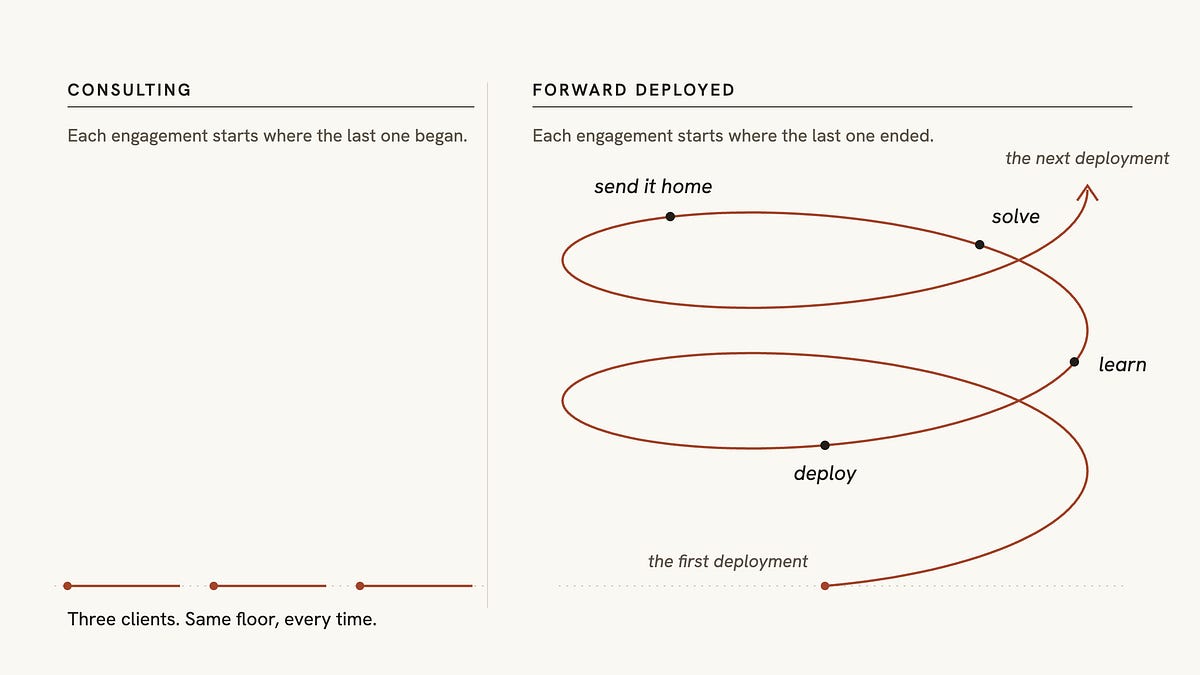
Strip away the jargon and the job is simple to describe. A forward deployed engineer (everyone writes FDE) sits between a company’s AI product and its customers. Instead of building features in an office, the FDE goes where the client is, figures out what they actually need, and builds it using the product they’re deploying.
Palantir invented the role nearly two decades ago. The name says the quiet part out loud: engineers who deploy forward, embedded with the customer instead of back at HQ. OpenAI runs its own version (they call the team Forward Deployed), and once the biggest AI company started hiring them, everyone else followed. There’s even a Wikipedia page for the job title now, created in June 2026, which is about as official as a job gets.
A rough split of the week: half consulting, half building. Morning call with a hospital chain about how their billing team works. Afternoon, you’re wiring up an AI workflow that drafts their denial letters. Then you demo it, get feedback, rebuild. The person doing this talks to humans all day and builds things all evening.
Why forward deployed engineer salaries hit half a million
The economics flipped, and that’s the whole story.
Two years ago, the bottleneck in AI was capability. Models couldn’t do enough to be useful in a real business. That’s over. Today’s models can draft contracts, triage support tickets, and analyze X-rays at useful accuracy. The bottleneck moved. Companies now have powerful AI and no idea how to wire it into their messy, actual workflows.
A forward deployed engineer solves it. Vinoo Ganesh, who led Palantir’s Spark program before co-founding Kepler, wrote about this on Latent Space: the job is best practices for showing up at a customer, learning their business in days (not months), and shipping something that works in front of them.
And companies pay through the nose for it. A thread on r/Salary in August 2026 documented jumps to $552k for people moving into forward deployed engineer roles, with $247k a common entry point at smaller firms. The Financial Times called forward-deployed engineers “the new hot job in AI” back in November 2025. The Pragmatic Engineer ran a deep dive in July 2026 that hit the front page of Hacker News with over 100 points, mostly engineers agreeing the demand is real.
When a job title gets that much attention that fast, it usually means supply is nowhere near demand. It still is.
A real day in the life
Job posts and FDE writeups paint a consistent picture. A typical Tuesday:
- 9am: customer call. The logistics company wants AI to read shipping manifests. You ask questions. Lots of them.
- 11am: you build a prototype in their environment. Maybe a chat interface over their documents, maybe an extraction pipeline. Tools like Claude Code or Cursor do the heavy lifting.
- 2pm: demo to their ops team. It works on 8 of 10 examples. Those two failures are the interesting part.
- 4pm: fix the edge cases, ship version two, write up what you learned.
Notice what’s missing: tickets, sprints, roadmap meetings. FDEs live in customer timezones and ship daily. It’s the most “real world” engineering job that exists, and honestly, the variety is why people don’t leave.
Skills you actually need (degrees optional)
Scan a hundred forward deployed engineer job posts and the same five things show up. None of them say “PhD required.”
- Tool fluency. You can build working things with AI tools: Claude Code, ChatGPT, agent platforms, automation tools. Not certifications, actual things.
- Communication. You translate “our process is kind of a mess” into a buildable workflow. Then you explain what you built in plain English.
- A domain. Healthcare, logistics, finance, legal. Knowing how one industry actually works makes you ten times more useful than a generalist.
- Bias to shipping. A rough demo today beats a perfect plan next month. FDEs prototype in front of customers and iterate live.
- Basic technical literacy. You don’t need to write production code from scratch, but you need to read it, debug it with AI, and understand APIs and databases at a conversational level.
That last one scares people, and it shouldn’t. Reading code with an AI assistant next to you is a learnable skill, and it’s exactly what the current wave of AI coding tools unlocked for non-engineers.
How to position yourself for one
No, you can’t apply to OpenAI’s FDE team tomorrow with a resume of PowerPoint skills. But the role has on-ramps, and the path is more visible than most six-figure careers.
- Build three real automations for a real business. Not tutorials. A friend’s shop, a local nonprofit, a former coworker’s agency. Document the before and after with numbers.
- Pick a domain and go deep. Read how your chosen industry bills, complies, and communicates. This is the part most tech people skip, which is why it’s your edge.
- Learn one stack end to end. Supabase for data, Claude Code for building, one automation platform for glue. Enough to ship a working demo solo.
- Look adjacent first. “Solutions engineer,” “implementation engineer,” “AI consultant,” and “customer engineer” are the same job with less brand name and lower bars. Get paid to do forward deployed engineer work at a smaller company, then jump.
- Turn expertise into proof. If you’ve worked in an industry, your knowledge of its pain points is the asset. Package it.
The jump is closer than it looks. Someone who spent five years in insurance claims plus six months of serious AI tool fluency is a genuinely competitive FDE candidate for insurance AI companies. That person beats a fresh CS graduate who’s never seen an insurance form.
What the job won’t do for you
Fair warning, because every “hot job” article skips this. Forward deployed engineer work involves travel, sometimes heavy. Customer emergencies are real emergencies when a hospital’s workflow dies at 2am. And the job title is young, so your parents will have no idea what you do (mine still don’t).
There’s also risk in the salary numbers. That $552k figure is a top-end outlier from one Reddit thread, not a median. Realistic entry FDE roles at startups land well below that, often $150k to $250k with equity. Still excellent. Just walk in with clear eyes.
The takeaway
The AI industry has a skills gap shaped exactly like this job: technical enough to build, human enough to translate. If you’ve got industry experience and you’re willing to get fluent with AI tools, a forward deployed engineer career is closer than you think. Start this week: pick your domain, build the first automation, and work through our guide to turning a coworker’s expertise into an AI skill, plus the AI tools that speed up a job search when you’re ready to send applications. The demand is real, the pay is documented, and the pool of qualified people is still tiny.