
Meta just handed over the keys to its biggest model. Muse Spark Open packs 816 billion parameters, a 1M-token memory, and you can download the whole thing today. Two Mac Studios can run it on your desk, or you can rent it by the token.
What Meta actually released
On October 15, Meta published the weights for Muse Spark Open, calling it the most capable US open-weight model to date. That’s not marketing fluff you can wave away, either. The numbers back it up: 816 billion total parameters with 42 billion active per token, a 1M-token context window, and native multimodal input. It was built for coding and agentic work, which means long tasks that stretch across hours instead of single chat replies.
If the name sounds familiar, that’s because it’s part of a bigger push. Meta launched Muse Wonder, its first frontier model, on October 12. The Muse agent already runs on Macs as a desktop assistant. Now the model layer underneath it is open for anyone to grab.
The parameter math, minus the jargon
Here’s what 816B total but 42B active actually means. Think of a hospital with 816 specialists on staff. When you walk in, only about 42 of them work on your case. The rest stay in the building, ready for other patients.
That’s a mixture-of-experts model in a nutshell. You get the knowledge of a giant model without paying the compute cost of a giant model on every single token. It’s the same trick behind several recent open releases, and it’s why models this size can respond at usable speeds.
The 1M-token context is the other headline. Entire codebases, long meeting transcripts, or a whole book series fit in memory at once. For agentic work, where the model needs to remember everything it did 500 steps ago, that’s the difference between useful and useless.
Multimodal, explained
“Natively multimodal” gets thrown around a lot, so here’s the plain version. Muse Spark Open handles more than text in and text out. Feed it screenshots, documents, or images and it works with them directly, no separate vision tool glued on the side. That matters for the desktop use case: an agent that can look at your screen, read your files, and act on both needs eyes built in, not bolted on.
Why open weights matter (and why this one is different)
Open models usually mean compromises. Companies release a smaller, weaker sibling of their best closed model, and you’re supposed to be grateful.
Meta went the other way. The company says this is the same class of model that competes at the front, not a dumbed-down sibling. You can read the full announcement and benchmark tables on Meta’s research blog, and the weights are already on Hugging Face.
This changes the open versus closed math that we’ve been tracking all year. Europe has Mistral Large 4, a trillion-parameter open model. China has DeepSeek and Qwen releases landing every few weeks. Now the US finally has an open-weight entry at the top of the range, and it comes from one of the biggest AI spenders on the planet.
Owning weights means you can run the model wherever you want, tune it on your own data, and never worry about a vendor pulling the API out from under you. We compared when the free option is enough in our open vs closed AI models guide. Muse Spark Open moves that line.
The two Mac Studio trick
The wildest part of the announcement isn’t the parameters. It’s where the model runs.
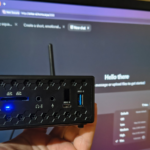
Meta optimized Muse Spark Open for Apple silicon using MLX, Apple’s machine learning framework. Two Mac Studio machines with M5 Ultra chips, linked together, hold the entire model. Apple’s unified memory gives each Mac up to 512GB for the GPU, and the 1.2TB/s memory bandwidth feeds the model fast enough to keep tokens flowing. Meta’s phrase for it: two Mac Studios behave like one supercomputer with a terabyte of unified memory.
The demos were real work, not tech demo theater. Meta ran its Muse Code agent on the model and shipped actual iOS changes to Ice Cubes, an open-source Mastodon client: bug fixes, new features, full builds. It also drove DaVinci Resolve end to end, reviewing footage frame by frame to find the strongest moments and crop them for vertical video.
That second one should make video editors pay attention. An agent that watches your raw footage and cuts a vertical version overnight is a workflow, not a gimmick.
On the performance side, Meta ships custom Helion GPU kernels with the open weights. They deliver 1.03x to 3.95x kernel-level speedups on NVIDIA and AMD GPUs, plus a 3% end-to-end gain on AMD’s MI350. Kernel-level numbers won’t translate directly to your workload, but faster is faster.
Ways to actually run it
You don’t need a Mac Studio pair to touch this model. Here are the main routes:
| Route | What you need | Best for |
|---|---|---|
| OpenRouter | An account, pay per token | Trying it in the next 10 minutes |
| Other API hosts | Account on Together AI, Fireworks, Groq, Baseten, Modal, or Nebius | Building apps on it |
| Your own hardware | Two Mac Studios with M5 Ultra chips plus MLX | Privacy, offline use, tinkering |
| Cloud weights | Hugging Face, Amazon SageMaker, Google Cloud, or Microsoft Foundry | Fine-tuning on your own data |
For most people reading this, OpenRouter is the move. Sign up, pick the model, and send a prompt. You’re paying pennies to test a model whose weights would need a small loan to run locally.
Beyond OpenRouter, the model works with all the major inference engines: SGLang, vLLM, TensorRT-LLM, Hugging Face Transformers, llama.cpp, Unsloth, and Apple’s MLX. It runs on AMD, Apple, Intel, and NVIDIA hardware. Nobody can claim vendor lock-in here.
The license catch
Now the fine print, because there’s always fine print.
The weights ship under the Muse Model License with limited commercial terms. Meta says many developers can use the model for free. Many, not all. If you’re planning to build a product on top of it, read the license before you write a line of code. Open weights are not the same as open source, and this license has strings attached.
There’s also the safety angle. Meta applied additional safety post-training and evaluated the model under its Superintelligence Scaling Framework before release. The model card on Hugging Face has the detailed results. Take that for what it’s worth, but the evaluation at least exists and is public.
Who should actually care
Skimmers, here’s the honest breakdown.
If you just use ChatGPT or Gemini through a browser, this changes your options more than your habits today. But it puts pressure on subscription prices. When a frontier-class model runs on rented hardware by the token, the “smart model tax” gets harder to justify.
Small business owners should pay closer attention. Running an open model on your own machines means customer data never leaves your office. For anyone handling sensitive client info, that privacy guarantee is worth more than a few benchmark points.
Tinkerers and developers, this is Christmas. Fine-tuning support comes through PyTorch’s TorchTitan, so you can adapt Muse Spark Open to your own data instead of wrestling an API into shape. And if you catch the local-AI bug after that, our guide to running Qwen locally on a gaming PC is the cheaper way in. The Mac Studio route is for people who already know they need it.
What to do first
Try it before you buy anything. Open an OpenRouter account, send Muse Spark Open your hardest current prompt, and compare the answer against whatever you use now. Ten minutes, a few cents, and you’ll know whether an 816B open model belongs in your toolkit.