
Walmart just flipped the switch on AI shopping: its Agent Gateway now lets chatbots like ChatGPT and Gemini browse and buy from Walmart and Sam’s Club on your behalf. Amazon still blocks those same agents at the door. Here’s what Walmart AI shopping actually does, what it costs you in control, and how to try it safely.
What Walmart actually launched
On October 21, the retailer rolled out three connected pieces: the Walmart Agent Gateway, Agent Profiles, and a written rulebook called terms for AI agents. Together they turn Walmart AI shopping from a hack into a supported feature. That’s a big deal, because until now, agents shopping online had to impersonate browsers, clicking through pages built for humans. It worked badly and broke constantly.
CEO John Furner announced the move at the Masters of Scale Summit, and the timing wasn’t random. Amazon had just started blocking AI agents from purchasing on behalf of shoppers. Walmart ran the other way, building the welcome mat instead.
The stakes are bigger than groceries. This is the first real test of agentic commerce at mass-market scale, where the store itself builds infrastructure for non-human customers.
The Walmart Agent Gateway, explained
The Gateway is a server built on the Model Context Protocol, or MCP, the connection standard Anthropic created. MCP gives AI agents a structured way to plug into external services, and Walmart’s version lets approved agents search the full inventory and complete purchases directly.
Why does that matter to you? Speed and reliability. A click-by-click agent can stall on a pop-up or mistype a quantity. An agent using the Gateway sends structured requests instead, so the whole thing behaves more like an API call than a robot smashing buttons.
There’s a privacy angle too. Say you buy the same sourdough bread and oat milk every week. The Gateway can help an agent reorder your usuals without handing over your broader purchase history or personal details. Walmart matches your saved preferences on its side; the agent never sees the whole picture.
The Gateway is live now in beta for companies and developers, and it already backs integrations with ChatGPT, Gemini, and Meta’s Muse. Everyday shoppers will touch it through those apps rather than through Walmart directly.
Agent Profiles: your agent gets its own lane
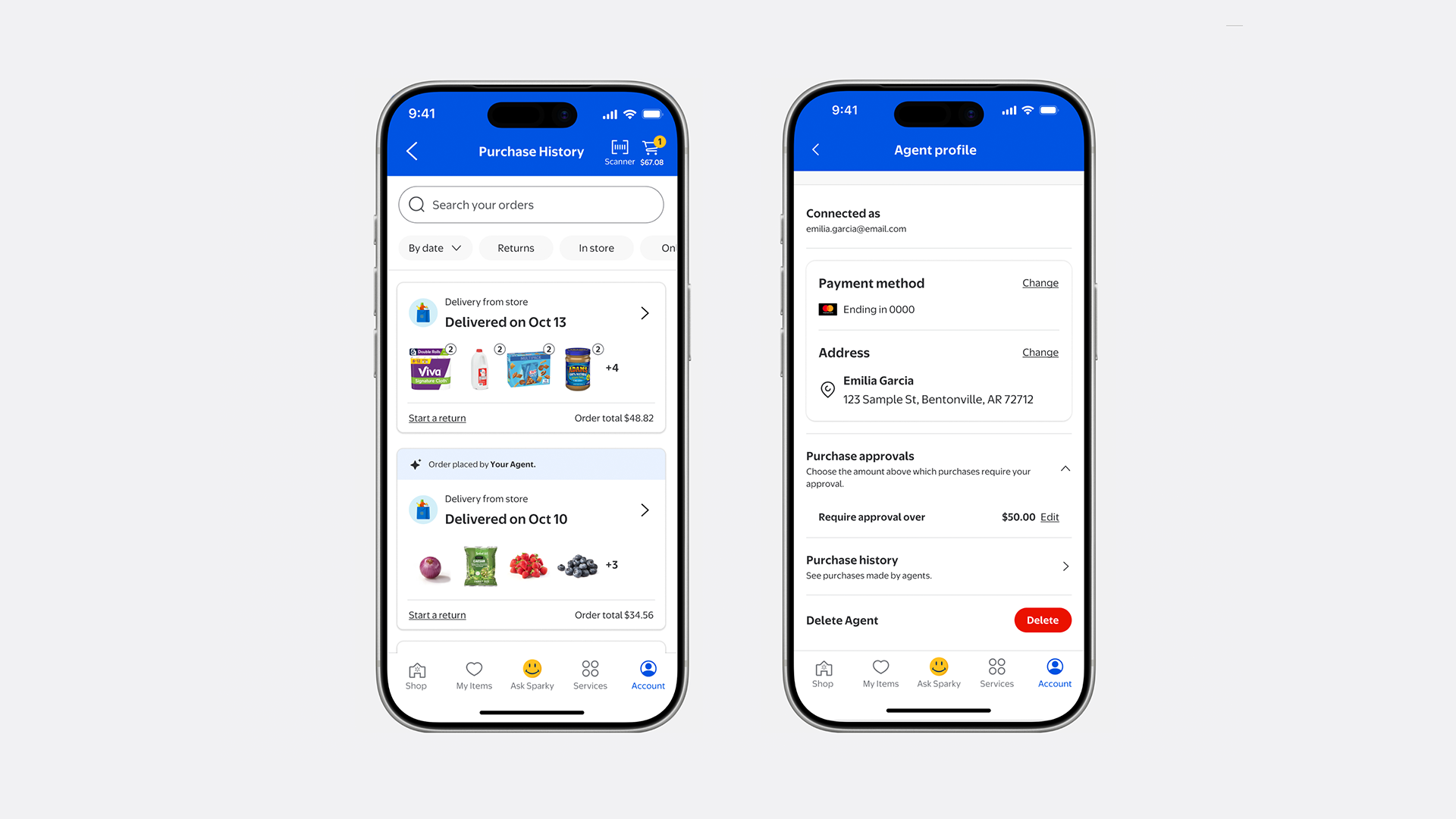
The feature most shoppers will actually notice arrives within the next month. Agent Profiles give each AI assistant a dedicated profile inside your Walmart account, so you can see exactly what the agent bought, separate from your own orders.
Setup happens automatically. The first time an agent shops for you through the Gateway, Walmart creates its profile. You then link it by signing into your Walmart account, and only Walmart sees that connection.
Then you set the guardrails, which work a lot like adding a family member to your credit card:
- Require approval for every single purchase, or
- Authorize the agent to buy on its own up to a spending limit you pick, like $50, $100, or $200.
- Review the agent’s orders in their own separate list.
- Delete the Agent Profile anytime. Done, agent locked out.
One detail deserves attention: prices stay identical whether a human or an agent is buying. Walmart states this outright, saying it prices products, not people. If you’ve been worried that agents would quietly steer you toward worse deals, that’s the reassurance Walmart is offering on paper.
The rules agents have to follow
Walmart didn’t just open the doors, it published a conduct code. The terms for AI agents read like a list of promises the store demands from the software:
- Customers are in control, and normal returns apply, even when the agent messed up.
- Purchase approval is on by default. Walmart can demand extra confirmation even below your spending limit.
- An agent can’t do anything beyond what you intended.
- Agents never receive your payment card information, and they can’t add or change payment methods.
- Agents only get the information your task requires.
- Break the rules, and the agent gets blocked from Walmart entirely.
That last one has teeth. Blocking is the enforcement mechanism, and Walmart gets to decide. Still, written rules beat no rules, and they give you grounds to complain when an agent goes rogue.
Walmart vs Amazon: two opposite bets
The split between America’s biggest retailers is stark. Walmart AI shopping runs on infrastructure, contracts, and published rules. Amazon treats the same agents like bots to be filtered out.
| Walmart | Amazon | |
|---|---|---|
| Official agent access | Yes, via the Agent Gateway (MCP) | Blocked |
| Purchase infrastructure | Purpose-built for agents | Agents must not purchase for shoppers |
| Purchase separation | Agent Profiles split agent orders from yours | Not applicable |
| Spending controls | Set limits per agent, revoke anytime | Not applicable |
| Written agent rules | Published, with blocking as penalty | Not applicable |
| Existing integrations | ChatGPT, Gemini, Meta’s Muse | None |
Why would Amazon lock out the future of shopping? Scale cuts both ways. Amazon’s marketplace is so vast that uncontrolled agents could strain its systems, invite pricing exploits, and pull the relationship away from its own app. Walmart sees agents as new front doors into the store. Amazon sees them as uninvited guests. For now, you get to vote with your cart, or rather, your agent does.
The agent economy is picking sides fast. Anthropic’s Claude Duet launched the same week with purchasing built in, and 1Password now manages agent logins without exposing your passwords. Stores and tools are all racing to define how humans stay in the loop.
How to try Walmart AI shopping without surprises
When Agent Profiles land, the careful path looks like this:
- Pick one agent you already use, like ChatGPT.
- Start the shopping flow inside that app, and let Walmart create the Agent Profile.
- Link it to your account, then set the tightest option first: approval for every purchase.
- Give the agent a small job, like reordering your usual snacks, and watch what it buys.
- Once you trust it, graduate to a small spending limit, maybe $50, and check the agent’s order list weekly.
Skip the temptation to hand over free rein with your full card on file. Not because the system is unsafe by design, but because every new agentic feature ships with rough edges, and your money deserves a probation period. This mirrors how AI try-on and shopping helpers crept into the buying journey: useful immediately, safest in small doses.
The takeaway
Walmart AI shopping is live through the Agent Gateway today, with Agent Profiles and spending limits rolling out over the next month. If you already use ChatGPT or Gemini, try one small agent-assisted order when profiles arrive, keep approvals on, and see how it feels. The retail wars just got an AI front line, and for once, the customer got the controls.