


Claude vs ChatGPT vs Gemini: Which AI Actually Helps You Learn?
Most AI comparison articles give you a feature checklist and call it a day. Here’s the problem with that approach: it tells you nothing about which AI will actually help you learn. You can compare context windows, pricing tiers, and plugin ecosystems all day, but more importantly, none of that matters if the AI you pick just hands you answers instead of teaching you how to think. I tested Claude, ChatGPT, and Gemini on real learning tasks — debugging code, learning new concepts, and breaking down complex topics — and the results were not what I expected.
Why Most AI Comparisons Miss the Point
The vast majority of claude vs chatgpt vs gemini for learning reviews focus on output quality: which one writes better code, generates more creative text, or gives faster responses. However, they miss the dimension that matters most for anyone trying to learn — teaching ability. Teaching is fundamentally different from answering. A good teacher doesn’t just give you the solution; they explain why the solution works, help you spot the mistake in your reasoning, and give you the tools to solve the next problem on your own.
In other words, the right question isn’t “which AI gives the best answer?” It’s “which AI makes me smarter after using it?” That’s what I set out to test.
What I Tested (and Why)
I looked at real head-to-head tests across multiple learning scenarios — not just one-off queries, but the kinds of tasks where an AI should function as a tutor:
- Debugging: Does it explain what went wrong, or just hand back fixed code?
- Learning new concepts: Can it break down something you’ve never seen before in a way that sticks?
- Complex topic explanations: How well does it simplify without dumbing down?
- Study help: Is it reliable enough for exam prep and homework?
Specifically, the most revealing test came from a real Python debugging challenge where all three AIs were given the exact same broken code. The results were telling.
Claude vs ChatGPT vs Gemini for Learning: The Real Test
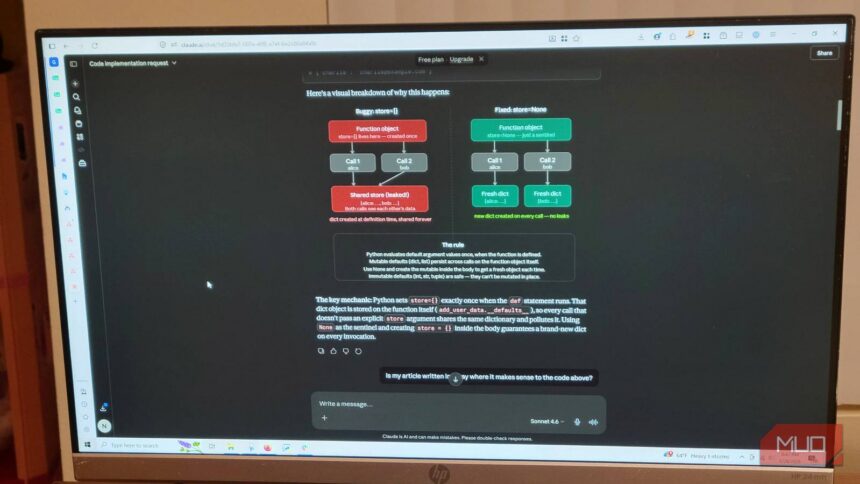
MakeUseOf writer Jorge Aguilar recently put Claude, ChatGPT, and Gemini head-to-head on a classic Python bug — the kind of mistake that silently corrupts data in production without throwing an obvious error. The bug involved a mutable default argument in a function definition. When you set a dictionary or list as a default parameter, Python only creates it once when the function is defined, not each time you call it. Every call ends up sharing the same dictionary, and data from one user can bleed into another’s session without anyone noticing.
This is exactly the kind of error where a good teacher makes all the difference. Any AI can spot and fix it. But can it explain why it happened in a way that prevents you from making the same mistake again?
Test 1: Debugging — Does It Teach or Just Fix?
Claude identified the root cause immediately. Then, instead of just patching the code, it walked through the problem step by step. Claude explained that Python stores default arguments on the function object at definition time — which means the same mutable object gets reused across every call. The fix, Claude showed, is to use None as the default and create a fresh object inside the function body. Most importantly, the developer understood why the fix worked and could apply that knowledge to similar problems in the future.
Gemini thought through the problem well and gave solid reasoning. The explanation was helpful, though not quite as thorough as Claude’s step-by-step breakdown. Still, a learner using Gemini would walk away with a decent understanding of what went wrong.
ChatGPT returned a fixed version of the code with zero explanation. Technically, the fix was correct — the code compiled and the error disappeared. Yet the developer gained nothing from the interaction. They didn’t learn what caused the bug, why the fix worked, or how to avoid it next time. As Aguilar put it: “ChatGPT didn’t just miss a teaching moment; it actively made the developer more dependent on asking the AI again next time.”
This is the heart of what developers call “vibe coding” — pasting code because the AI said so without understanding what changed. It feels like productivity, but it’s actually building dependency.
Test 2: Learning a New Concept from Scratch
Beyond the debugging test, multiple independent comparisons show a consistent pattern across learning tasks. Claude tends to explain the underlying principles before giving an answer, while ChatGPT jumps straight to the solution. For example, when asked to explain a concept like recursion, Claude typically starts with an analogy, builds up to the formal definition, then shows a concrete code example. ChatGPT is more likely to skip straight to the code example with a brief description. If you already understand the basics, ChatGPT’s approach is faster. If you’re learning from scratch, by contrast, Claude’s layered explanation actually sticks.
Test 3: Explaining Complex Topics Simply
This is where Claude’s design philosophy really shines. Anthropic published a 28,000-word “Constitution” that governs Claude’s behavior — and it prioritizes values and reasoning over rules and compliance. One of the key differences: Claude is explicitly trained to disagree with you when your approach is wrong. This pushback is intentional. Amanda Askell, one of Anthropic’s philosophers, has explained that an entity with values generalizes better than one with just rules.
In practice, this means Claude is more likely to say “actually, that approach won’t work because…” rather than “great idea!” followed by code that doesn’t quite solve the problem. Consequently, honest feedback from Claude is infinitely more valuable than false encouragement from an AI that agrees with everything.
On the other hand, ChatGPT has a well-documented sycophancy problem. OpenAI’s own Model Spec literally includes “don’t be sycophantic” as a behavioral directive — which means the company knows it’s a problem and is actively trying to fix it. The issue traces back to a reward signal based on user thumbs-up and thumbs-down feedback. In April 2025, an update to GPT-4o made the model so agreeable that it felt “overly supportive but disingenuous.” When your AI tutor agrees with everything you say — including your mistakes — you’re not learning. You’re being validated.
Test 4: Study Help and Exam Prep
For straightforward factual questions and study summaries, all three AIs perform reasonably well. Nevertheless, Claude has two distinct advantages for students. First, its 200K-token context window (roughly 500 pages) means you can paste entire textbook chapters or long documents and ask specific questions without losing context. ChatGPT’s 128K window is smaller, though still generous for most study tasks. Additionally, Claude includes built-in response styles — including an “Explanatory” mode that automatically adjusts output to be more teaching-focused. With ChatGPT, you need to manually prompt for this style every time.
Meanwhile, Gemini’s strength here is research — Google’s model is excellent at pulling in recent information and synthesizing sources. For exam prep where you need the latest data, Gemini has an edge. As a result, when it comes to pure tutoring depth, Claude doesn’t quite match Gemini’s research ability, but Claude surpasses Gemini in teaching quality.
Which AI Is Best for Learning? The Results
After looking at real tests across multiple learning scenarios, here’s how the three compare:
Claude: The Best Teacher Overall
Claude consistently explains its reasoning before giving answers. Furthermore, its constitutional training makes pushback a feature rather than a bug. For anyone choosing an AI specifically to learn from — whether that’s coding, writing, studying, or picking up a new skill — Claude is the clear winner. The explanations stick, the feedback is honest, and you walk away actually understanding the material instead of just having a working answer.
Ultimately, if you’re deciding between subscriptions, Claude is the one that makes you smarter over time rather than more dependent on the AI.
ChatGPT: Fast Answers, Shallow Explanations
ChatGPT is undeniably fast and generally reliable for straightforward tasks. If you already know what you’re doing and just need a quick answer, it gets the job done. However, for learning, its tendency to skip explanations and agree with everything creates a shallow experience. You get the answer without the understanding — which means you’ll be back asking the same question next time.
As evidence, MakeUseOf’s Shimul Sood documented that ChatGPT’s decline in quality is a real issue. In head-to-head tests on routine tasks, Claude consistently outperformed GPT — not just in output quality, but in the ability to actually help the user improve.
Gemini: Good for Research, Weaker for Teaching
Gemini sits in the middle. Its reasoning is solid, and Google’s integration with Search gives it an advantage when you need up-to-date information. For research-heavy learning tasks, it’s genuinely useful. That said, as a teacher — someone who breaks down concepts step by step and catches your misunderstandings — it doesn’t quite match Claude’s depth.
ChatGPT vs Claude for Students: A Practical Guide
If you’re a student trying to decide which AI subscription is worth your money, here’s the practical breakdown:
Best Use Cases for Each AI
Use Claude when:
- You’re learning something from scratch and need clear, step-by-step explanations
- You want honest feedback that catches your mistakes, not just agrees with you
- You’re studying long materials and need a large context window
- You want an AI that functions as a genuine tutor, not just an answer machine
Use ChatGPT when:
- You already understand the topic and just need quick answers
- You’re doing creative writing or brainstorming where speed matters more than depth
- You use other OpenAI tools (DALL-E, Sora, etc.) and want everything in one place
Use Gemini when:
- You need the latest information or real-time data
- You’re doing research that benefits from Google’s search integration
- You want a decent free tier that covers basic learning needs
When to Switch Between Them
The honest truth is that no single AI is perfect for every learning task. Ideally, you should use Claude as your primary learning tool — the one you go to when you actually need to understand something — and keep Gemini or ChatGPT as a secondary option for quick lookups and research. If you’re only paying for one subscription, though, Claude gives you the most learning value per dollar.
If you’ve already made the switch, you’re not alone — as we covered in our piece on why more people are cancelling ChatGPT, Perplexity, and Gemini to use Claude instead, the trend is clear.
How to Get the Best AI for Learning (Without Wasting Money)
AI subscriptions add up. At $20 per month each, trying all three costs $720 per year. Here’s how to make a smart choice without wasting money.
Free Tiers vs Paid — What Actually Matters
All three AIs offer free tiers, and for casual learning, the free versions are worth trying before you commit:
- Claude Free: Generous daily limits with access to the latest models. Enough for light learning — a few study questions per day, some debugging help, and basic concept explanations.
- ChatGPT Free: Includes GPT-5 mini with decent capabilities. Good for quick questions, though the free tier is more limited than Claude’s.
- Gemini Free: Google’s free tier is generous, especially for research-heavy tasks that benefit from Search integration.
For serious learners — students, career switchers, anyone studying intensively — the paid plans unlock significantly better models and larger context windows. As a result, if you’re using AI to learn every day, the upgrade from free to paid is genuinely noticeable.
The One AI Subscription Worth Paying For
If you can only pick one, Claude Pro ($20/month) is the best investment for learning. Here’s why: you get access to the best teaching model, the largest context window, and response styles designed specifically for learning. The key insight is that the value comes from what you retain — and studies consistently show that explanations which build understanding beat answers that build dependency.
If you want to access multiple AI models without paying three separate subscriptions, an OpenRouter account lets you use Claude, ChatGPT, and Gemini from one place for a fraction of the cost.
Final Verdict: Which AI Should You Use to Learn?
In summary, claude vs chatgpt vs gemini for learning isn’t a close contest. Claude is the only one designed from the ground up to explain its reasoning, push back when you’re wrong, and actually teach rather than just answer. ChatGPT gives you fast solutions but shallow understanding. Gemini is a solid middle ground — great for research, decent for teaching, but not exceptional at either.
For beginners choosing their first AI subscription, the choice is clear: pick the AI that makes you smarter, not the one that makes things easiest. Claude costs the same as ChatGPT, but what you actually learn is dramatically different. If you want to understand why Claude feels more human than ChatGPT, it comes down to how it was built — and that difference shows up in every learning session.
Start with the free tier, test all three on something you’re genuinely trying to learn, and see for yourself. The AI that makes you say “oh, now I get it” is the one worth paying for.
Frequently Asked Questions
Is Claude better than ChatGPT for learning?
Yes, based on multiple head-to-head tests. Claude consistently explains its reasoning and helps you understand the underlying concepts, while ChatGPT tends to skip explanations and jump straight to answers. For this reason, anyone trying to actually learn will find Claude’s approach builds real understanding.
Which AI is best for students?
Claude is the best overall AI for students, thanks to its large context window (200K tokens), built-in Explanatory mode, and honest feedback that catches mistakes. ChatGPT is good for quick answers, and Gemini excels at research, but neither matches Claude as a teaching tool.
Can ChatGPT teach me a new subject?
ChatGPT can help, but it’s not the strongest teacher. Its tendency to agree with incorrect approaches and skip explanations means you may end up with working answers but shallow understanding. In contrast, for learning a subject from scratch, Claude is more effective.
Is Gemini good for studying?
Gemini is decent for studying, especially when you need up-to-date information from Google’s search integration. That said, for deep conceptual understanding and step-by-step teaching, Claude outperforms it. Gemini is a good secondary tool alongside Claude.
What is the best AI chatbot for homework?
Claude is the best AI chatbot for homework help because it explains the reasoning behind its answers rather than just giving solutions. This helps you actually learn the material, which is the whole point of homework in the first place.