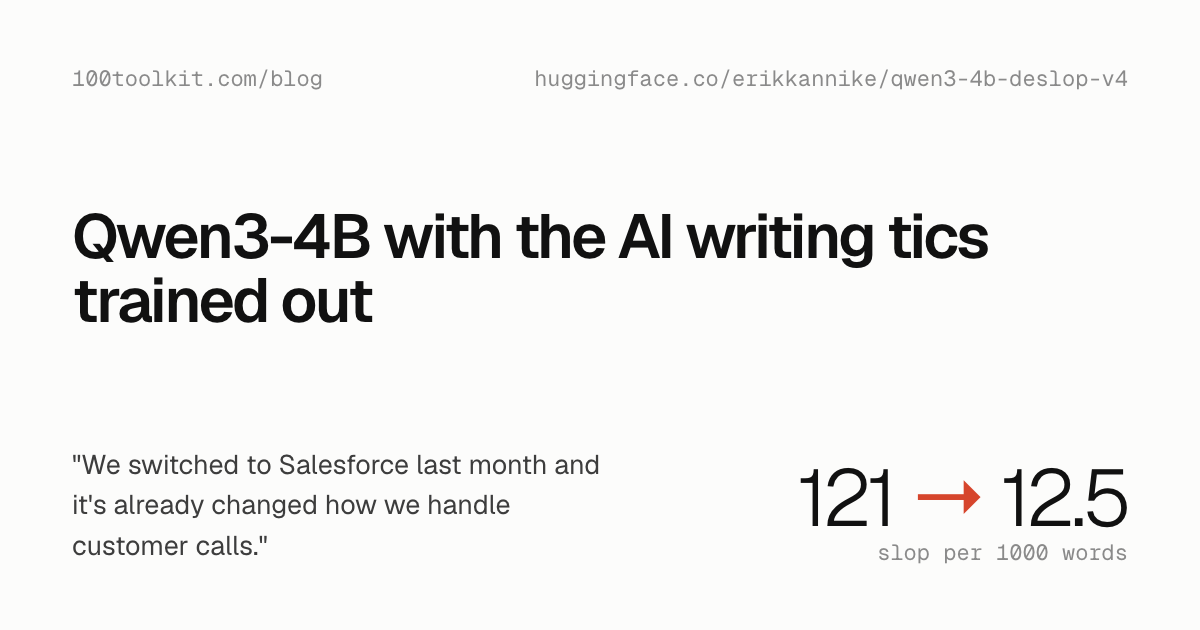

An AI model that no longer writes like an AI model. That’s the whole pitch behind Qwen3-4B de-slop, a free model someone retrained in a home lab to break its own robotic habits. It went viral on Hacker News today, and it might be the most honest AI release of the month.
What “slop” actually means
You know it when you read it. Every sentence hedges. Em dashes everywhere. The rule-of-three lists. “It’s not just X, it’s Y.” Bold headers, emoji bullets, that weird signposting voice that sounds like a corporate training video. People call it AI slop, and detectors, employers, and clients are getting sharp at spotting it.
The weird part is where the slop lives. It isn’t in the model’s knowledge. It’s in its manners. A model can be factually solid and still open every paragraph with “In today’s fast-paced world” because that’s what it learned from mountains of AI-generated training text.
One researcher got tired of it and did something about it. Not with a clever prompt. With surgery on the model itself.
What Qwen3-4B de-slop actually is
The model is a retrained version of Qwen3-4B-Instruct-2507, a small open model from Alibaba’s Qwen family. The retrain was done by an independent developer, and the modified weights are free on the official Hugging Face page. Four billion parameters means Qwen3-4B de-slop runs on ordinary hardware. No data center required.
The changes targeted specific writing habits, trained out of the weights directly:
- Em dashes
- The “not X, but Y” construction
- Lists of three
- Signposting language
- Buzzwords
- Bold headers and emoji in prose
And here’s my favorite detail: it was built on a MacBook Air. The creator trained a LoRA (a small adapter layer, think of it as a patch that nudges the model’s behavior without rebuilding it) and combined it with four precise edits to individual neurons the researcher had identified as the slop controls. No giant cluster, no lab budget. A laptop and a lot of patience.
The before and after numbers
The creator ran both models through a test of 40 writing prompts across ten topics the model never saw during training, covering blog posts, LinkedIn posts, explainers, and opinion pieces. Here’s the scoreboard.
| Metric | Original Qwen3-4B | De-slop version |
|---|---|---|
| Slop score per 1,000 words | 121 | 12.5 |
| Answers at human level (score under 15) | 0% | 68% |
| Em dashes per 1,000 words | 20.5 | 0.0 |
| “Not X, but Y” per 1,000 words | 7.8 | 0.8 |
| Lists of three per 1,000 words | 17.3 | 1.1 |
| Factual and arithmetic accuracy | 97% | 100% |
| Follows requested genre and length | 78% | 80% |
For context, human writing usually scores under 15 on this scale. The original model sat at 121, which is roughly eight times sloppier than a person. The de-slopped version lands at 12.5, inside human range, and 68% of its answers now score as human-level.
The knowledge held up too. Where facts were concerned, the original answered 97% of test questions correctly, and the retrained model got 100%. Teaching a model better manners didn’t make it dumber, which is the failure mode everyone feared with this kind of experiment.
The catch (there’s always a catch)
Read the fine print and you’ll find the trade. About 5% of Qwen3-4B de-slop’s test answers came back “damaged,” meaning a lowercase start or broken punctuation. The researcher is upfront that this is the cost of poking neurons directly, and says no blind human study has validated the scoring method yet. Honestly, the slop detector itself is one person’s style guide turned into code, which is honest but not gospel.
The bigger limitation for everyday use: every training answer was short, around 250 words. So on long outputs the model can fall into repeating one sentence pattern. The fix is mechanical, not magical. Run it with a repetition penalty of 1.1, temperature 0.7, and top-p 0.9, and keep your expectations realistic past a few hundred words. Long-form training data is planned for a future version.
How to run it yourself
If you’ve got a computer from the last few years, you can run Qwen3-4B de-slop tonight. The easiest path is Ollama, a free app that runs AI models locally with one command. After installing Ollama, open a terminal and type:
ollama run hf.co/erikkannike/qwen3-4b-deslop-v4-GGUF:Q4_K_M
That downloads a compressed copy (about 2.5GB) and starts a chat. The Ollama version ships with the right settings built in, so the repetition penalty handles itself. If you prefer Python, the full-precision weights load with the transformers library exactly like the original model, no special code.
Not sure if your machine can handle it? If it has 8GB of RAM or more, you’re fine. We’ve covered the broader trend in running Qwen 3.8 locally on a gaming PC and the smaller stuff in local LLM tasks worth running on your phone. This one sits in the middle: lighter than a gaming-PC build, heavier than a phone app.
What a small local model is actually good for
Four billion parameters won’t out-think the big cloud models, and that’s fine, because most everyday writing isn’t a reasoning problem. Where this class of model earns its keep: drafting short posts and replies, rewriting your own paragraphs in a cleaner voice, summarizing notes, and quick factual lookups you then verify. The de-slop version specifically shines at the rewrite job, since clean prose is literally what it was retrained for.
The privacy angle matters more than people admit. Running locally means your text never leaves your machine. No account, no usage policy, no chat log on someone else’s server. For drafts you wouldn’t paste into a cloud chatbot (client work under NDA, personal stuff, anything sensitive), that’s not a bonus feature. It’s the whole point.
It also works offline. On a flight, in a dead-zone cabin, on a metered connection, the model keeps working. That’s something no subscription chatbot can offer, because they all need the round trip to a data center.
Why this little model matters
Because it points at something bigger than one model. If one person with a MacBook Air can retrain the slop out of a 4B model in a home lab, then “sounds like AI” is about to stop being a reliable signal for anyone. The arms race between AI detection and AI normalcy just tilted.
There’s an economic angle too. We’ve written before about the human premium, where human-made work earns more precisely because it’s rare. Models like this squeeze from the other side: when the cheap stuff stops sounding cheap, the premium has to come from somewhere else entirely. Taste, judgment, actual expertise. The boring old things.
Should you bother?
Run Qwen3-4B de-slop if you draft any text with a local model, or if you’re just curious what “AI without the tics” reads like. It’s free, it’s small, and the experiment itself is worth five minutes of anyone’s time. Just feed it short tasks, keep the settings it ships with, and don’t hand it your 3,000-word newsletter yet. The next version is supposed to fix exactly that.