
$3 million. That’s the training bill Xiaomi says it paid for MiMo-V2.6-Pro, an open AI model that just debuted as the strongest open-weights model on the board. For scale, that’s less than some startups spend on office snacks.
Why this release matters
Here’s why you should care even if you’ve never trained anything.
The models most people use live behind subscriptions and API bills. Open-weights models are different: the weights get published, anyone can download them, and companies can run them on their own servers. Whenever the top open model jumps forward, prices across the whole industry feel it. Competitors can’t charge premium rates for something a phone company trained for the cost of a used Toyota.
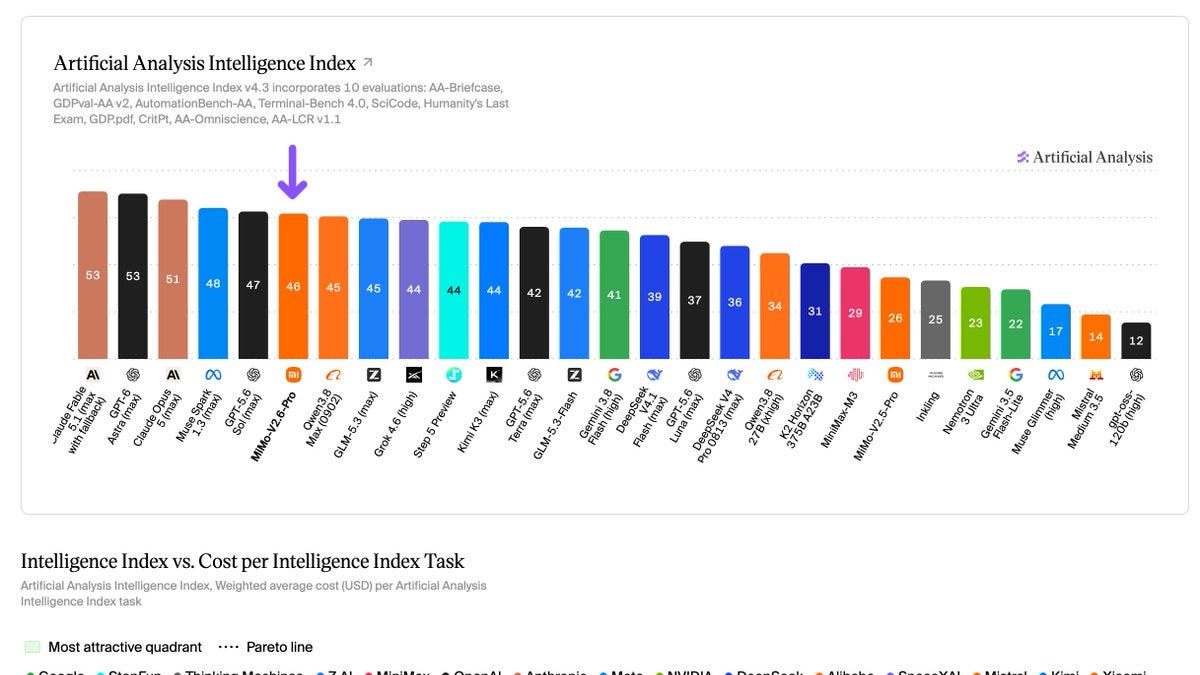
That’s exactly what just happened. Xiaomi, the company you probably know for phones and scooters, released the MiMo-V2.6 family: Pro, Flash, and a speed-tuned variant called Pro-UltraSpeed. Independent evaluators at Artificial Analysis scored MiMo-V2.6-Pro as the new top open-weights model on their Intelligence Index, and their cost math put it on the efficient edge of the price-performance curve.
Xiaomi isn’t one of the famous Chinese AI labs everyone watches. It’s a hardware company crashing the party, and the established labs should be nervous.
The $3 million training run
The headline number is real, and the backstory is almost as interesting as the price.
Xiaomi scaled up reinforcement learning along three axes, according to its technical report: bigger batches with training runs at up to a million tokens of context, a wider mix of task environments (coding, general agent work, visual tasks, even security challenges), and much heavier compute spent grading the model’s attempts. The MiMo-V2.6-Pro model itself is a mixture-of-experts design with 1.02 trillion total parameters, of which about 42 billion fire at any moment. That design keeps inference cheap without gutting capability.
The weirder part: Xiaomi streamed its final RL training runs live on a public dashboard, metrics and all. A former DeepSeek engineer, Fuli Luo, now at Xiaomi, drove that transparency push. The discussion on Hacker News hit hundreds of points, which tells you how rare this is. Labs usually guard training curves like state secrets.
Most of the training tooling is open source too. The recipes, the environments, the agent configs: all published. The full task datasets haven’t dropped yet, but the direction is clear. If you’ve ever wondered whether the free, open model is enough for real work, releases like this keep tilting the answer toward yes.
What does an MIT license actually buy you? Practically speaking: download the weights, run them on your own servers, fine-tune them on your company’s data, build a product on top, and never send a customer’s byte to anyone else. For businesses handling sensitive information (medical, legal, financial), that’s not a nice-to-have. It’s the whole ballgame, and it’s why startups keep choosing open weights over big-name APIs where the contract allows.
Zoom out and the timing gets more interesting. This launch lands in the middle of a ten-week sprint of major open releases from Chinese labs: Kimi K3, Qwen3.8-Max, DeepSeek V4-Pro, GLM-5.3, and more. Bloomberg reporting suggests startups are increasingly building on open weights to cut costs and reduce dependence on a handful of US providers. MiMo-V2.6-Pro didn’t appear in a vacuum. It’s the new head of a crowded, fast-moving pack.
Real prices, not hype
Specs are fun until the bill arrives. So here’s the part you’ll actually use.
The MiMo models are already listed on OpenRouter, which means you can route everyday AI work to them through one account instead of juggling providers. I pulled these numbers directly from OpenRouter’s live model catalog:
| Model | Input per 1M tokens | Output per 1M tokens | Context | Notes |
|---|---|---|---|---|
| MiMo-V2.6-Pro | $0.435 | $0.87 | 1M | Omnimodal, top open-weights score |
| MiMo-V2.6-Flash | $0.14 | $0.28 | 1M | The cheap workhorse |
| DeepSeek V4-Pro | $0.919 | $1.84 | 1M | Strong, text-only |
| GPT-5.2 | $1.75 | $14.00 | 400K | Closed flagship |
| Claude Opus 4.8 | $5.00 | $25.00 | 1M | Closed premium option |
Read the output column twice. MiMo-V2.6-Pro generates text for roughly a third of what GPT-5.2 costs and about 3% of Opus 4.8’s rate. One variant, Pro-UltraSpeed, buys up to 20x faster output at much higher prices, which makes sense for real-time apps and almost nothing else.
Numbers move, and every lab ships discounts eventually. Even so, the gap here isn’t a rounding error. It’s a different pricing universe.
What “omnimodal” means for you
Omnimodal sounds like marketing foam, so let me translate.
The MiMo-V2.6 models accept text, images, audio, and video as input, and they were trained that way from the start rather than bolting vision onto a text model later. In practice, you can feed the model a product photo and ask for a listing description, drop in a meeting recording and get minutes, or point it at a screen recording and ask what went wrong. One model, all the media types small businesses actually deal with.
Compare that with older workflows where you’d chain a transcriber, an image captioner, and a text model together. Each link adds cost, latency, and another place to break. And if you’d rather keep everything in-house, running capable open models on your own hardware keeps getting easier too.
The Flash variant deserves a mention too. At $0.14 per million input tokens, it’s priced for automation: classification jobs, support ticket triage, batch summarizing. Those small tasks add up to real money when you run thousands of them.
How to try it today
No GPU farm required. Here’s the quick path.
- Create an account at OpenRouter and grab an API key.
- Pick your model:
xiaomi/mimo-v2.6-profor tough jobs,xiaomi/mimo-v2.6-flashfor cheap volume work. - Point any chat app or automation tool that supports OpenRouter at that model string. Tools like Cherry Studio, LibreChat, or a plain curl script all work.
- Run your usual task and compare the output quality against whatever you’re paying for now. Keep receipts.
If you want to go deeper, the weights and technical report live on Hugging Face under the XiaomiMiMo org, and the full AI news roundup at Latent Space covers the training details. We also reviewed DeepSeek’s budget-friendly flagship if you want another open option to benchmark against.
Not sure what to test first? Give each model the job it’s priced for. Throw a pile of support emails at Flash and ask for one-line summaries. Hand Pro something harder: a contract clause to explain, a dataset to interrogate, a long document to outline with citations. Then run the same tasks on your current premium model and compare. Ten minutes of testing tells you more than any leaderboard.
The takeaway: try MiMo-V2.6-Pro on your real workload this week, not a toy prompt. If it holds up, you just cut your AI bill by 90% and lost nothing but the premium logo.